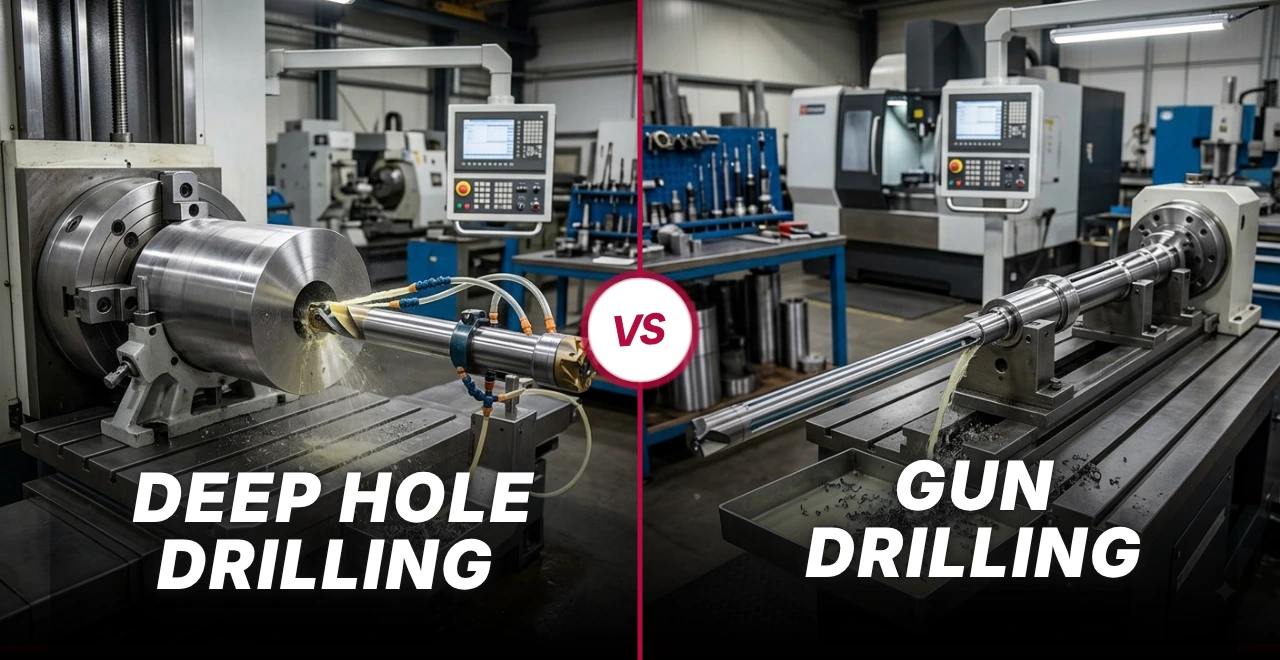

Any time a hole’s depth runs well beyond its diameter, specialised drilling methods come into their own. That’s the territory deep hole drilling covers, and two methods lead the way: gun drilling and BTA drilling (Boring and Trepanning Association). Both are excellent at producing straight, precise, deep bores, and each brings its own strengths through different tooling, coolant paths, chip evacuation, and ideal diameter ranges.
Worth clarifying from the outset: Deep Hole Drilling vs Gun Drilling is best understood as a relationship rather than a rivalry. Deep hole drilling is the umbrella category, and gun drilling is one valuable method within it, alongside BTA deep hole drilling as another. Below, we’ll walk through how each one works, where their strengths diverge on a technical level, and how to choose confidently between them for a real application, including what is the difference between gun drilling and deep hole drilling, and when to use gun drilling instead of deep hole drilling.
What Is Deep Hole Drilling?
The general rule of thumb is a depth-to-diameter (L/D) ratio above 10:1, though the exact threshold naturally varies depending on the industry and application. Rather than a single technique, deep hole drilling is a well-developed family of processes:
- Gun drilling
- BTA drilling
- Ejector drilling
- A range of other specialised deep-hole methods
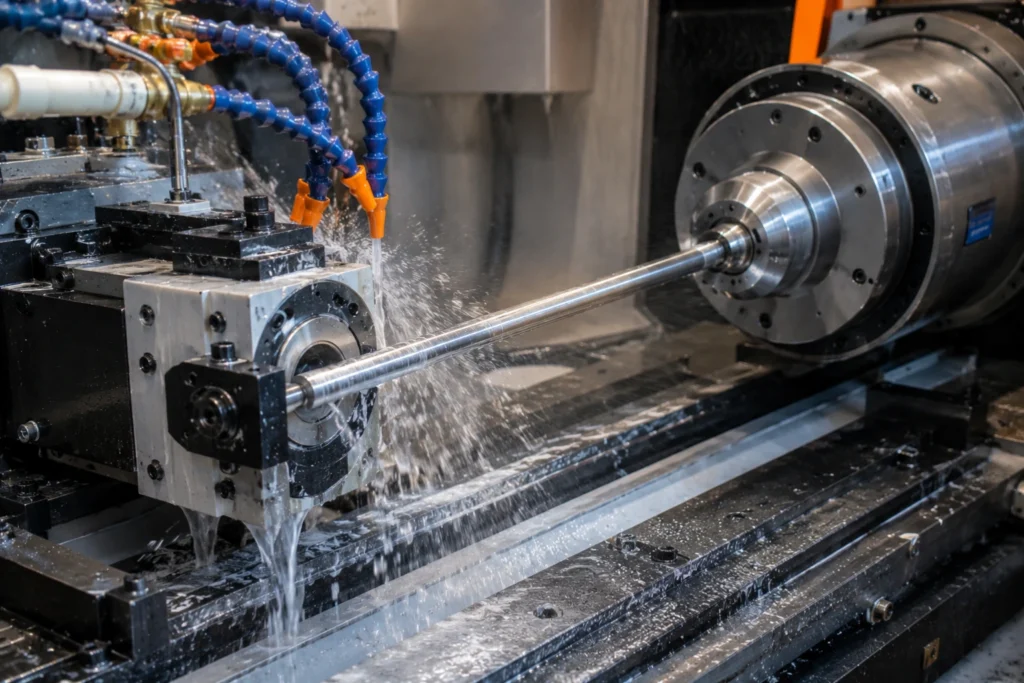
Gun drilling and BTA together cover the great majority of real-world work, including CNC deep hole drilling operations on modern machining centres. Deep, narrow bores call for a purpose-built approach, since a long, unsupported cutting path benefits from dedicated engineering to manage deflection, vibration, heat, and chip flow. Deep hole drilling systems are designed specifically to excel at this, and that’s exactly what makes precision deep hole drilling possible: coolant delivered right to the cutting edge, a dedicated path for chips to leave the bore, and tooling engineered to stay true over a long run.
Gun Drilling: Precision at Smaller Diameters
Gun drilling is a superb choice for smaller, high-precision bores. The tool itself is a single-lip, asymmetrical drill, fed with high-pressure coolant straight through its core.
Gun drill geometry
The tip has one cutting edge, offset from centreline, supported by one or two guide pads riding just behind it. This is a deliberate and elegant design choice. The guide pads use the freshly cut bore wall itself as a reference surface, so the tool essentially guides itself with excellent accuracy, working in harmony with spindle alignment rather than relying on it alone. It’s a self-correcting setup, and it’s a big part of why gun drilling achieves such impressive straightness over long lengths.
Fluid dynamics
- Coolant runs through a bore drilled into the shank and tube, arriving right at the cutting edge under pressure
- Chips travel out along an external V-flute cut into the tool, carried smoothly by the same coolant flow
- The single edge plus the guide pads keep everything beautifully centred as the tool advances
Those guide pads do excellent double duty: they stabilise the tool mechanically, and the contact they maintain against the bore wall naturally burnishes the surface along the way, which is one reason gun-drilled holes finish so cleanly.
Where it’s used
Gun drilling typically handles bores from roughly 1 mm up to 50 mm, with tooling and machine setups also available beyond this range for specialised needs. It shines wherever straightness, roundness, and surface finish are top priorities: fuel injection components, medical instruments, hydraulic parts, and other precision work.
BTA Drilling: Built for Larger, Deeper Bores
BTA drilling offers a complementary approach, purpose-built for the larger end of the job: bigger diameters, higher volume, and substantial material removal. The coolant and chip paths are elegantly reversed compared to gun drilling.
Tool-head architecture
A BTA head carries multiple cutting edges arranged around a hollow drill tube, with guide pads performing a similar role to gun drilling but scaled up for a larger, robust system. That hollow tube serves two purposes beautifully: it moves chips, and it gives the head excellent structural rigidity, which becomes especially valuable at larger diameters and higher feed rates.
Fluid dynamics
- Coolant flows around the outside of the tool, through the gap between the tube and the bore wall, reaching the cutting zone under high pressure
- Chips are guided into the hollow centre of the drill tube right at the cutting head
- From there, the fluid flow carries them smoothly back out through the tube and clear of the workpiece
Stock removal
That internal chip path, combined with the multi-edge cutting head, is what allows BTA deep hole drilling to handle larger chip loads and achieve higher material-removal rates at bigger diameters. Typical BTA territory runs from around 20 mm up into 300 mm and beyond, depending on the machine and tooling on hand. It can deliver substantially higher productivity than gun drilling at larger sizes, with the exact advantage shaped by material, diameter, depth, tooling, and available coolant pressure and machine power. This is why BTA is a trusted choice across heavier industrial work: hydraulic cylinder bores, mould cooling channels, and large shafts and rolls.
Gun Drilling vs BTA Drilling: Side-by-Side Comparison
| Parameter | Gun Drilling | BTA Drilling |
| Typical bore size | Smaller diameters (approx. 1-50 mm) | Larger diameters (approx. 20-300+ mm) |
| Coolant path | Through the tool | Around the outside of the tool |
| Chip evacuation | Along external V-flute | Through hollow drill tube |
| Tool structure | Single-lip, asymmetrical | Multi-edge, supported head |
| Typical application | Small, high-precision bores | Large, deep industrial bores |
| Productivity | Strong at smaller diameters | High material-removal rates at larger sizes |
At its heart, the comparison comes down to one elegant design choice: where the coolant goes in, and where the chips come out. Gun drilling sends fluid through the tool and lets chips travel out along an external flute. BTA does it in reverse: fluid flows around the tool, and chips travel back out through the middle. Every other strength on this list, from rigidity to power requirements, flows naturally from that one design choice. That single distinction is really the heart of Gun Drilling vs BTA Drilling as a technical comparison.
Choosing the Right Method for Your Application
The decision comes down to four straightforward factors: bore diameter, depth, tolerance requirements, and production volume.
Gun drilling is an excellent choice when:
- The bore is small, well under 20 mm
- Straightness, surface finish, and tight tolerances are the top priority
- Volumes are lower, or precision is valued above cycle time
BTA is an excellent choice when:
- The bore is larger, generally 20 mm and up
- Cycle time and material-removal rate are just as important as finish, or more so
- The application involves heavy components like hydraulic cylinders or large-diameter shafts
Below roughly 20 mm, gun drilling is generally the natural fit, since standard BTA tooling is optimised for larger bores from the outset. This is a helpful general guideline, and it’s always worth confirming the best approach with your machining partner based on the specific part geometry and material.
One application worth highlighting covers gun drilling vs deep hole drilling for hydraulic cylinders: in hydraulic cylinder manufacturing, BTA is often the efficient first pass, roughing out the large bore quickly and leaving an excellent surface ready for finishing operations like skiving and roller burnishing. Gun drilling adds real value too, particularly on smaller-diameter cylinder work where tight tolerance is the priority.
FAQ
What is the difference between gun drilling and deep hole drilling?
Deep hole drilling is the broader category covering any high L/D-ratio bore. Gun drilling is one valuable method within that category, working alongside BTA drilling rather than competing with it.
When to use gun drilling instead of deep hole drilling as a whole?
The most accurate way to frame this is when to use gun drilling instead of BTA drilling, since both are valued members of the deep hole drilling family. Gun drilling is typically the strong choice when the bore is smaller, roughly under 20 mm, and straightness, finish, and tolerance are the priority.
Can BTA drilling be used for small-diameter holes?
BTA is at its best on larger diameters, thanks to its hollow-tube design that enables efficient internal chip evacuation. For smaller-diameter holes, gun drilling is the ideal, purpose-matched choice.
Which method produces a better surface finish?
Gun drilling is celebrated for excellent finish and straightness at smaller diameters, thanks to the guide-pad burnishing effect. BTA also delivers strong, reliable results, particularly at the larger diameters where its design truly shines.
What is the best drilling method for long deep holes?
Both methods excel in their respective ranges. Gun drilling is ideal for smaller, precision-critical bores, while BTA is ideal for larger diameters where removal rate is a priority. The right choice comes down to matching the diameter, depth, tolerances, and volume of the job to the method built for it.