- +971 48858090 / +971 566851956
- info@accurateedgeuae.com
- Dubai Investment Park 1
Dubai Investment Park 1 is home to Accurate Edge’s automated shot peening facility, built to handle components as large as 15 inches in diameter and 12 meters long. We’ve grown into one of the region’s go-to shot peening companies in Dubai, working across oil & gas, aerospace, and general manufacturing, and strengthening parts as varied as turbine blades and long oilfield components.
Fatigue life isn’t something you can eyeball. It has to be engineered in, consistently, on every part that leaves the facility. That’s the standard operators across the UAE expect when they bring shot peening services to Accurate Edge, and it’s the standard we hold ourselves to.
What Is Shot Peening?
Shot peening is a cold working process, and a fairly elegant one once you understand what it’s actually doing. Small spherical media, called shots, get fired at high velocity onto a component’s surface. Each hit leaves a tiny dent, barely visible, but underneath that dent sits something far more useful: a layer of compressive stress baked into the metal itself.
That layer does the heavy lifting. Metal parts under repeated load don’t usually wear out in the way people picture. They develop a crack somewhere, often microscopic at first, and that crack grows a little with every cycle until it doesn’t. Peening pushes back against exactly that mechanism, strengthening the surface from the inside rather than protecting it from the outside. A landing gear component, a turbine blade, a gear tooth, these earn their long working life because the metal itself has been reinforced, not just finished nicely.
Our peening runs on automated equipment at Accurate Edge, which means shot size, intensity, coverage, and how the component moves through the process are all tightly controlled. The part that comes off the line today gets treated the same as the one that came off six months ago.
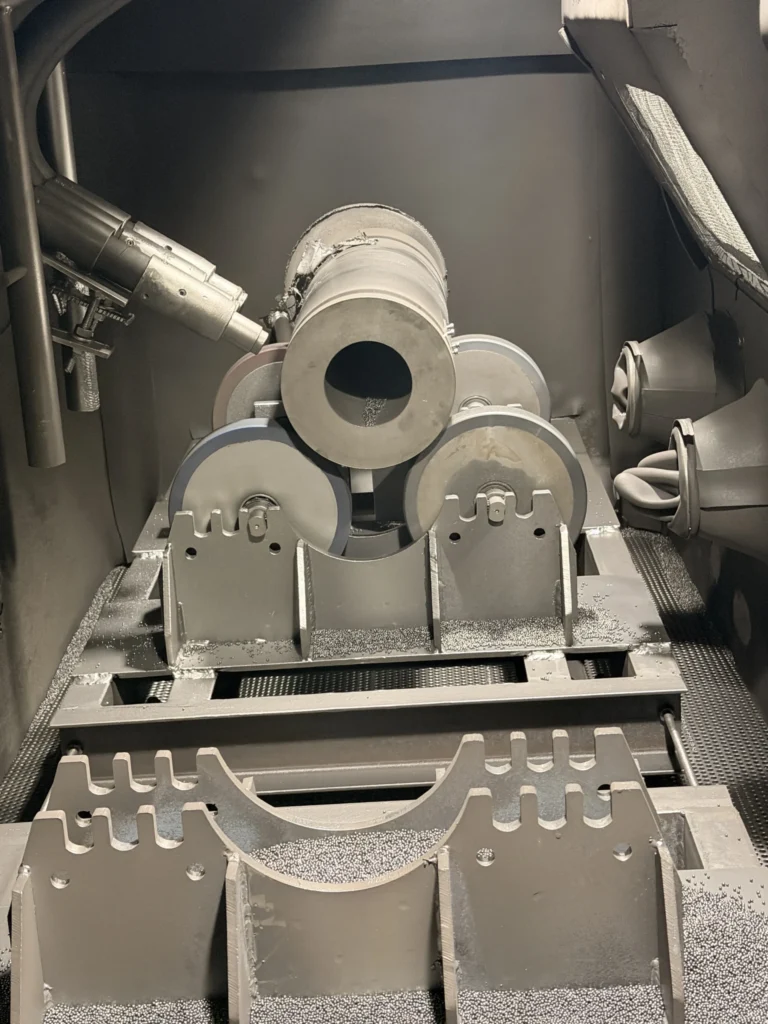
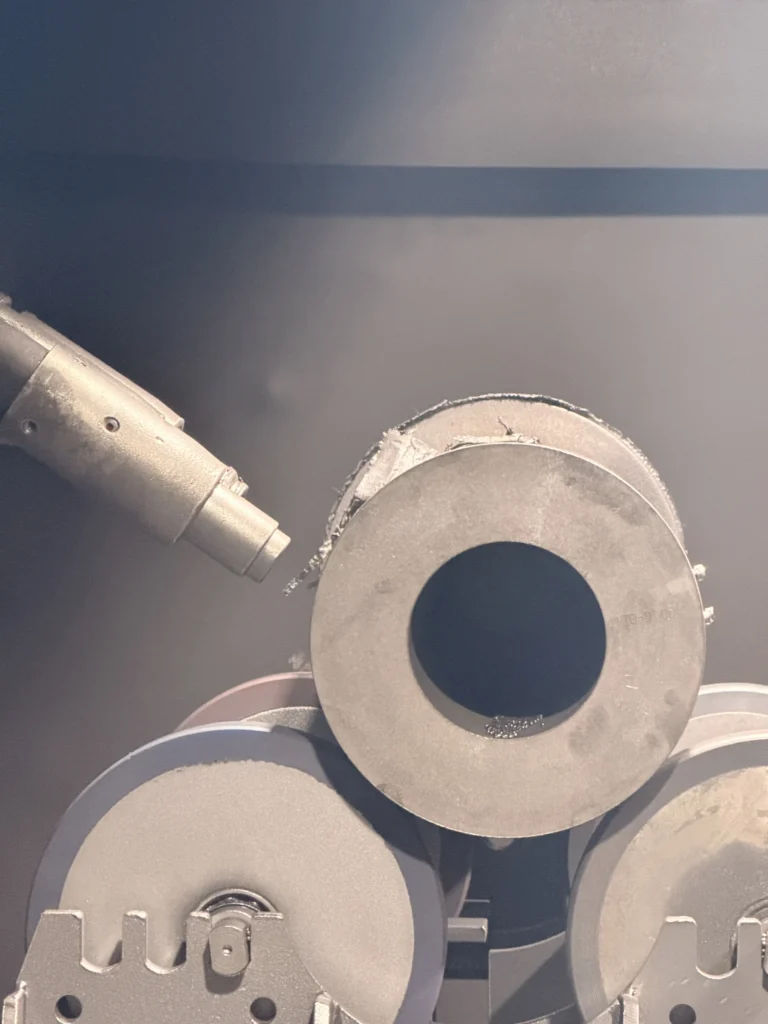
Key Features of Our Shot Peening Services:
Consistency is really the whole story here, so it’s worth spelling out where it comes from.
- Automated processing: Shot size, intensity, and coverage are controlled on every pass, not adjusted by feel from one operator to the next.
- Room for genuinely large parts: Up to 15 inches in diameter and 12 meters long, handled in one facility rather than farmed out because of size.
- Internal diameter peening too: Bores down to a 4 inch minimum diameter, treated to a depth of up to 1.3 meters per side.
- Shot sizes from S070 to S780: Matched to whatever the component and the relevant standard call for.
- Coverage that’s actually verified, not assumed, against controlled processes and industry-approved standards.
- A setup built around oil & gas, aerospace, and manufacturing: the sectors where long or complex components show up most often.
Benefits of Shot Peening
Fatigue life is the big one. That compressive layer works directly against the tensile stress that limits how long a part survives under repeated load, and the improvement can be substantial.
Stress corrosion cracking gets harder to develop, too. Parts working in corrosive conditions under load are exactly where this failure mode shows up, and peening gives them meaningfully better odds.
The surface itself gets stronger, not just protected. That’s the difference between peening and most other treatments. It’s not a coating sitting on top of the metal, it’s a change to the metal.
Wear resistance improves as a side effect of the same hardening. Not the main reason to peen a part, but a welcome one.
Put it all together and you get components that stay in service longer and behave more predictably while they’re there, which is really the entire point of doing this in the first place.
Applications of Shot Peening
- Aerospace: landing gear, turbine blades, engine components, structural parts.
- Automotive: gears, springs, crankshafts, connecting rods, transmission components.
- Oil & Gas: valves, drilling equipment, high-pressure components.
- Power Generation: turbine parts, rotating equipment.
- Manufacturing & Engineering: tools, dies, molds, precision-engineered components.
Different industries, same underlying reason. Wherever a component has to survive years of repeated load without warning before it fails, shot peening tends to be part of the spec.
Why Choose Accurate Edge?
Most workshops can run a part through a peening cabinet. Fewer can hold consistent coverage across a 12 meter component, document shot intensity against a real spec, and do it to industry-approved standards, in one place.
- Capacity that actually fits: A long or oversized part sent to Accurate Edge gets treated whole. No splitting the job across suppliers because of length or diameter.
- Real control, not general blasting: Shot size, intensity, coverage, and component movement are all set precisely, which is what turns peening into a repeatable, documented process instead of a rough finish.
- We’re building for years of service, not the delivery date: Properly peened components hold up under repeated load for the long haul, and our process controls exist so every part gets that same benefit, not just the ones someone happens to double-check.
- Trusted across the industries that need it most: Aerospace, oil & gas, automotive, power generation, and general manufacturing clients across the UAE and GCC send us work where fatigue life genuinely matters.
- Right in the middle of it all: Dubai Investment Park 1 puts our shot peening facility close to Abu Dhabi, Sharjah, and the rest of the GCC supply chain.
FAQ about Shot Peening Services
Externally, up to 15 inches in diameter and 12 meters in length. For internal surfaces, we offer bore peening down to a 4 inch minimum diameter, treating depths of up to 1.3 meters per side. Between the two, most long or complex parts get handled in full without needing a second supplier.
A coating sits on the surface. Polishing changes how the surface looks. Shot peening does something different entirely, it builds compressive stress just under the surface, which reinforces the base metal against the fatigue loads it’ll face in service. Nothing gets added on top. The metal itself is what changes.
S070 through S780, and every job runs against controlled processes and industry-approved standards for coverage and intensity. That range gives us the flexibility to match treatment to the part rather than running everything through the same setup regardless of what it actually needs.
Aerospace (landing gear, turbine blades, engine and structural components), automotive (gears, springs, crankshafts, connecting rods, transmission parts), oil & gas (valves, drilling equipment, high-pressure components), power generation (turbine parts, rotating equipment), and general manufacturing (tools, dies, molds, precision-engineered parts). The common thread isn’t the industry, it’s the demand: a component has to survive years of repeated load, and fatigue life can’t be an afterthought.