
Every weld hides a quiet danger. The instant the arc moves on, the metal it just fused begins cooling unevenly, locking in residual stress and leaving behind a hardened, brittle microstructure in the heat-affected zone. Left alone, that hidden stress can warp components, trigger sudden cracking, and set the stage for failures that show up months or years after the weld was signed off.
Post-weld heat treatment (PWHT) is the critical solution to this problem. It is a controlled process of reheating a welded material to a specific temperature, holding it there, and then cooling it down slowly, relieving the stresses and restoring the properties that welding disturbs.
In this guide, you’ll learn what PWHT welding actually involves, how it differs from general heat treatment, why it’s required, when it becomes mandatory, exactly how the procedure is carried out step by step, and answers to the most common PWHT questions.
What is Post-Weld Heat Treatment (PWHT)?
Short answer: PWHT is a controlled heat, hold, and cool cycle applied to a welded component to relieve residual stress and restore its mechanical properties.
In more detail, PWHT involves three coordinated stages. First, the welded component is reheated gradually to a specific target temperature, almost always below the material’s lower critical transformation point. Second, it’s held, or “soaked,” at that temperature for a set period of time. Third, it’s cooled back down slowly and evenly, in a controlled environment, rather than being left to cool in open air.
The goal throughout is twofold: to relieve the residual stresses locked in by the intense, uneven heating and cooling of the welding process, and to alter the mechanical properties of the heat-affected zone so the joint regains ductility, toughness, and stability closer to that of the surrounding base metal.
PWHT vs. Heat Treatment: What’s the Difference?
Short answer: Heat treatment is the broad umbrella term for any controlled heating and cooling process; PWHT is a specific type of heat treatment applied strictly after welding.
General heat treatment can happen at virtually any stage of manufacturing, during casting, forging, or final finishing, to achieve desired base material properties such as hardness, ductility, or grain structure. It’s a broad category that covers many different processes and goals.
PWHT, by contrast, is specifically performed after a welding process is complete, to fix the localized damage and stress introduced by the welding arc itself in the heat-affected zone (HAZ). It isn’t concerned with the whole component’s baseline properties; it’s targeted at undoing the specific disruption welding causes.
| Feature | General Heat Treatment | Post-Weld Heat Treatment |
| Timing | Any stage of manufacturing (casting, forging, final product) | Strictly after a welding operation has been completed |
| Primary Goal | Altering fundamental properties (hardening, softening, changing phase) | Relieving residual stresses and restoring baseline properties in the HAZ |
| Scope | Often applied to the entire component evenly | Usually localized to the weld seam and surrounding metal, though full-furnace PWHT exists |
Understanding pwht vs heat treatment as terms matters when reviewing a welding procedure specification. A component may have already undergone general heat treatment earlier in manufacturing, but that doesn’t exempt a welded joint from also needing PWHT afterward if the code or material calls for it.
Why is PWHT Required?
Short answer: PWHT is required because welding locks in residual stress, creates a hardened microstructure, and traps hydrogen, all of which can lead to cracking and failure if left untreated.
Stress relief. As a weld cools, the intense heat causes localized expansion followed by rapid contraction. Because this happens unevenly across the joint, it locks in significant residual stress. PWHT relaxes these stresses before they can cause warping, distortion, or cracking under later service loads.
Microstructure tempering. The heat-affected zone often ends up with a hard, brittle microstructure as a direct result of the welding thermal cycle. PWHT tempers this structure, restoring ductility and toughness so the joint can flex and absorb load the way the original design intended, rather than fracturing under stress.
Hydrogen outgassing. Welding can trap hydrogen inside the weld metal and HAZ. If that hydrogen isn’t given a chance to escape, it can combine with a hardened, stressed microstructure to trigger hydrogen-induced cracking (HIC), sometimes hours or days after the weld appears complete. The controlled heating during PWHT gives trapped hydrogen time to diffuse safely out of the material, substantially lowering this risk.
Together, these three mechanisms explain the post weld heat treatment requirement on so many welded structures: without it, a joint can look sound on the surface while carrying stress, brittleness, and hidden cracking risk underneath.
When to Post-Weld Heat Treat? (Requirements & Codes)
Short answer: PWHT is typically triggered by material thickness, alloy composition, and the governing industry code, and in many cases it’s mandatory rather than optional.
Material thickness. As a general rule of thumb, carbon steel thicker than roughly 1.5 inches commonly requires PWHT, since thicker sections trap significantly more residual stress through their cross-section as they cool. That said, this threshold varies by code, service application, and joint design, so it should always be confirmed against the applicable specification rather than assumed.
Alloy composition. Certain high-alloy steels, such as Chrome-Moly (Cr-Mo) grades commonly used in high-temperature piping and pressure vessels, almost always require PWHT regardless of thickness. Their alloying content makes them especially prone to forming hard, crack-sensitive microstructures in the HAZ.
Industry codes. Beyond material science, post weld heat treatment requirement is heavily dictated by engineering codes, including:
- ASME Boiler and Pressure Vessel Code, for pressure vessels and boiler components
- ASME B31.3, for process piping
- AWS D1.1 (Structural Welding Code), for structural steel applications
For fabricators working on ASME- or API-stamped projects, skipping PWHT where it’s specified isn’t just a quality risk. It can mean a component fails inspection and certification entirely.
Pre and Post Weld Heat Treatment: The Complete Cycle
Short answer: Pre-heating happens before and during welding to slow the cooling rate and prevent immediate cracking, while PWHT happens afterward to relieve residual stress and ensure long-term structural integrity.
Pre-heating means warming the base metal before welding begins. Its purpose is to slow down the cooling rate of the weld metal as the arc passes, giving trapped hydrogen more time to escape and reducing the chance of forming a brittle, crack-prone HAZ in the first place.
The synergy between the two is what makes them a complete cycle rather than two unrelated steps. Pre-heating prevents immediate cracking during and right after the weld is made, while PWHT ensures long-term stability and structural integrity once the joint has fully cooled. Understanding pre and post weld heat treatment as a paired system, rather than treating PWHT as an isolated afterthought, is essential for anyone specifying or reviewing a welding procedure on critical infrastructure.
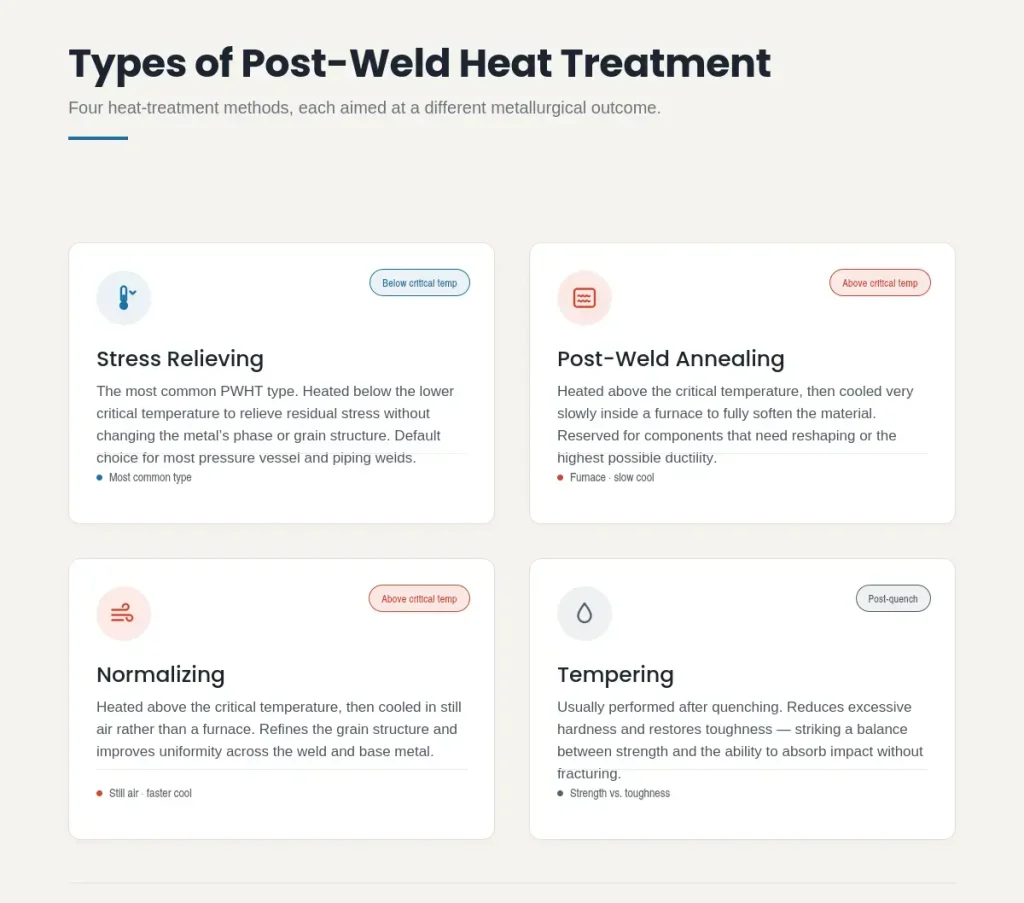
Types of Post Weld Heat Treatment
Short answer: The main types of post weld heat treatment are stress relieving, post-weld annealing, normalizing, and tempering, each targeting a different metallurgical outcome.
- Stress relieving: The most common type of PWHT. The component is heated below its lower critical temperature to relieve residual stress without changing the metal’s phase or significantly altering its grain structure. This is the default choice for most pressure vessel and piping welds.
- Post-weld annealing: The metal is heated above the critical temperature and then cooled very slowly, usually inside a furnace, to soften the material fully and maximize ductility. It’s typically reserved for components that need further reshaping or the highest possible ductility for their service conditions.
- Normalizing: This involves heating the metal above its critical temperature and then cooling it in still air, refining the grain structure and improving uniformity across the weld and base metal.
- Tempering: Usually performed after quenching, tempering reduces excessive hardness and restores toughness, striking a balance between strength and the ability to absorb impact without fracturing.
Choosing the correct type isn’t just a matter of preference. It’s driven by the base material, the welding process used, the component’s intended service environment, and the governing code, all of which should be confirmed before the thermal cycle ever begins.
The PWHT Procedure: How is it Actually Done?
Short answer: The PWHT procedure follows three controlled stages: gradual heating, holding at temperature, and slow, controlled cooling, carried out with furnaces or localized heating equipment.
Step 1: Controlled heating:
The component is heated gradually, typically at a specified rate measured in degrees per hour based on material thickness. This rate must be strictly controlled; heating too quickly risks thermal shock, which can introduce new stresses before the treatment even accomplishes its goal.
Step 2: Holding, or soaking, time:
Once the target temperature is reached, the component is held there for a specific duration. The common industry rule of thumb is roughly one hour of soak time per inch of material thickness, though exact figures depend on the material grade and applicable code.
Step 3: Controlled cooling:
The cooling rate must be just as slow and controlled as the heating rate, bringing the component down to an ambient or safe handling temperature gradually rather than exposing it to open air. An uncontrolled cool-down at this stage can reintroduce the very stresses PWHT was meant to remove.
Equipment used. For smaller components or shop-based work, an entire part can be placed inside a furnace for a fully uniform thermal cycle. For large, fixed structures like pipelines and pressure vessels that can’t be moved, localized ceramic heating bands or induction coils are wrapped directly around the weld joint, allowing the thermal cycle to be applied precisely where it’s needed without relocating the component.
Throughout the process, temperature is continuously monitored and recorded with thermocouples attached to the weld and surrounding base metal, creating a documented thermal record that becomes part of the quality package for inspection and certification.
Frequently Asked Questions (FAQs)
Can PWHT be done locally?
Yes. Localized PWHT is commonly performed using ceramic heating bands or induction coils wrapped directly around the weld joint, which is especially useful for large, fixed structures like pipelines and pressure vessels that can’t be moved into a furnace.
What happens if you skip PWHT?
A weld that skips required PWHT is left carrying its full residual stress and hardened microstructure. This significantly increases the risk of premature cracking, warping, and failure under load, particularly in high-pressure or corrosive service environments.
Does PWHT weaken the weld?
No. When performed correctly to the specified temperature and time, PWHT restores ductility and toughness rather than weakening the joint. It’s specifically designed to bring the weld’s properties back in line with the base material.
What temperature is used for PWHT?
The target temperature depends on the material grade, but it’s almost always set just below the metal’s lower critical transformation temperature. The exact figure is defined in the Welding Procedure Specification (WPS) or governing code, not a single universal number.
How long does PWHT take?
Duration depends on material thickness and the applicable code, but soak time is commonly calculated at roughly one hour per inch of thickness, plus the time needed for controlled heating and cooling on either side.
Is PWHT the same as preheating?
No. Preheating happens before and during welding to slow the cooling rate and reduce immediate cracking risk. PWHT happens after welding is fully complete, to relieve the residual stress and restore properties that remain once the joint has cooled.
Key Takeaways
- PWHT is a controlled heat, hold, and cool cycle applied after welding to relieve residual stress.
- It differs from general heat treatment in timing and scope: PWHT is strictly a post-welding, HAZ-focused process.
- It’s required to prevent stress-related warping, microstructural brittleness, and hydrogen-induced cracking.
- Thickness, alloy composition (like Chrome-Moly steels), and codes such as ASME, ASME B31.3, and AWS D1.1 all determine when it’s mandatory.
- Pre-heating and PWHT work as a paired system, before and after the weld, to manage cracking risk from start to finish.
- Common types of post weld heat treatment are stress relieving, post-weld annealing, normalizing, and tempering.
Conclusion
Post-weld heat treatment stands between a weld that merely looks complete and one that’s genuinely fit for decades of demanding service. By relieving residual stress, tempering the hardened microstructure in the HAZ, and allowing trapped hydrogen to escape safely, PWHT plays a direct role in a welded structure’s safety, code compliance, and long-term longevity.
As with any critical process, the exact parameters, heating rate, soak time, and cooling rate, should always be confirmed against your specific Welding Procedure Specification (WPS) and the relevant governing code rather than assumed from general guidelines.
Have a project that needs PWHT done right? At Accurate Edge, our team handles welding and post-weld heat treatment services and equipment for clients across the UAE, from stress relieving on piping welds to full furnace and localized PWHT on pressure vessels. Get in touch with us to discuss your project, or drop a comment below with any questions about your specific application.