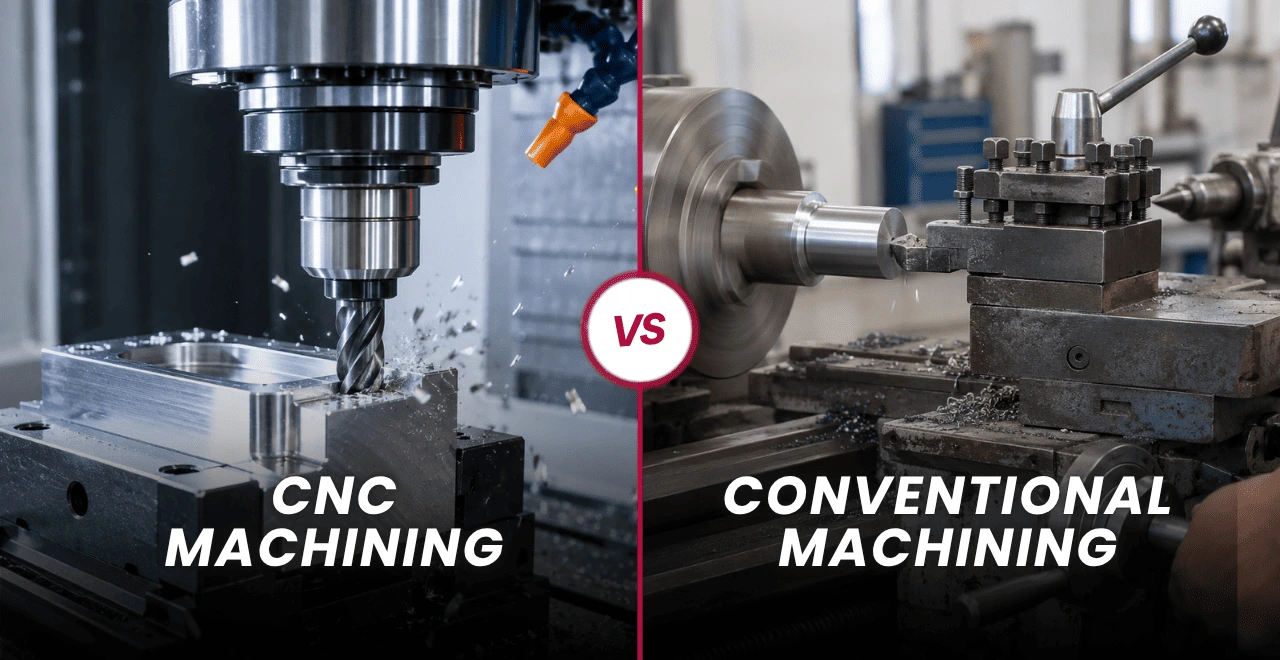

Quick Answer: CNC machining vs conventional machining comes down to precision, repeatability, and volume. CNC machining uses computer-controlled equipment to run programmed toolpaths with excellent accuracy and consistency, even across large production runs. Conventional machining relies on manually operated equipment guided directly by a skilled machinist. CNC is usually the stronger choice for complex parts, tight tolerances, and repeat orders, while conventional machining can still be a smart, cost-effective option for simple, low-volume, or one-off components.
The UAE’s manufacturing sector is growing fast, and buyers across oil and gas, aerospace, and automotive are asking sharper questions before choosing a machining method these days. The good news is that getting this decision right isn’t complicated once you know what actually matters.
This guide gives you a clear, practical CNC vs conventional machining comparison. We’ll look at how each method actually works, where the real cnc vs conventional machining pros and cons show up, what to expect on cnc vs conventional machining cost, and how to choose confidently for your next component.
CNC Machining vs Conventional Machining: Key Differences
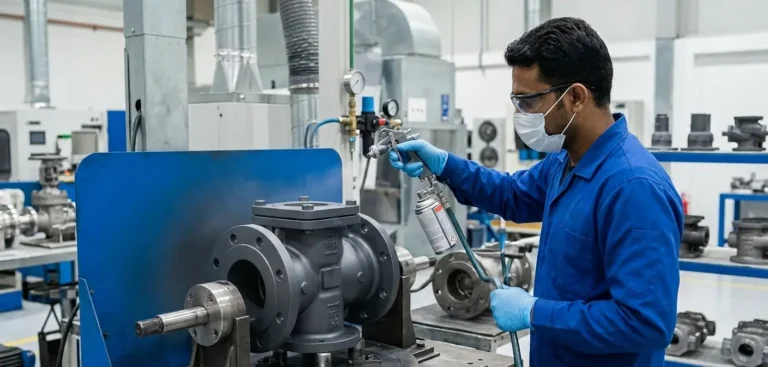
Conventional machining uses manually operated equipment, lathes, mills, drills, and grinders, controlled directly by a machinist adjusting feed rate, speed, and tool position by hand. Precision depends heavily on the operator’s skill and experience, and no two parts come out quite the same way.
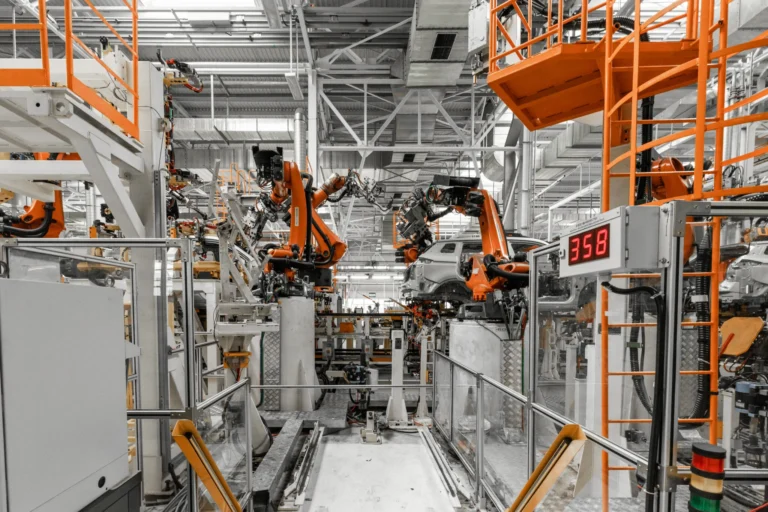
CNC (Computer Numerical Control) machining takes a different approach. A CAD model of the part is created, then CAM software converts that design into machine-readable code. The CNC machine then runs that program on its own, with very little operator input needed once everything’s set up. Once the program is validated, every part that comes off the machine matches the last, within very tight tolerances.
That’s really the core idea behind every CNC machining vs traditional machining comparison. Conventional machining depends on the machinist’s hands, while CNC machining depends on the program and the rigidity of the machine running it.
CNC vs Conventional Machining Pros and Cons
Both methods are still widely and successfully used across UAE manufacturing today, and each has its place. Here’s a simple side-by-side view before we go into more detail.
| Factor | Conventional Machining | CNC Machining |
| Precision | Depends on operator skill | Consistently high, program-controlled |
| Repeatability | Varies part to part | Excellent across large runs |
| Setup Time | Faster for one-off jobs | Longer upfront, faster after that |
| Complex Geometries | Difficult | Handles multi-axis parts well |
| Labour Requirement | Skilled machinist needed throughout | Skilled programmer upfront, lighter load after |
| Best Suited For | Simple parts, prototypes, low volume | Tight tolerances, complex parts, medium to high volume |
Conventional machining really earns its keep on a single prototype or an urgent one-off repair, where a skilled machinist can make real-time adjustments mid-job rather than stopping to reprogram anything. It’s also handy for highly customised work, where no two parts are quite alike anyway.
CNC machining, on the other hand, is where you want to be once quality needs to stay consistent across hundreds or thousands of parts. It handles multi-axis geometries and tight tolerances with ease, keeps accuracy steady regardless of operator fatigue, and makes repeat orders noticeably faster and more predictable.
CNC vs Conventional Machining Cost
Here’s some more good news: neither method is automatically the “expensive” one. It really depends on your specific project.
CNC machining usually costs more upfront, thanks to programming, CAM software, and machine setup. For a single part or a very small batch, conventional machining can actually work out cheaper. But as order quantity grows, CNC’s cost per part drops significantly, since that programming and setup cost gets spread across the whole run. Conventional machining, by contrast, needs a skilled machinist’s time for every single part, so per-unit labour cost stays fairly flat no matter how many you order.
There’s also the cost of mistakes to think about. Conventional machining carries a slightly higher risk of small inconsistencies creeping in between parts, especially on long runs, and that can mean scrap or rework costs that are easy to overlook at the quoting stage. CNC machining’s repeatability keeps that risk low once a program is proven. Tooling costs tend to be broadly similar either way for the same material, though CNC’s steady feed rates often extend tool life compared with the natural variability of manual cutting.
In short, cnc vs conventional machining cost favours conventional machining for small, simple, one-off jobs, and favours CNC machining as soon as volume, complexity, or tolerance requirements go up.
CNC Machining Advantages Worth Knowing
Beyond cost and volume, there are a few genuinely useful CNC machining advantages worth keeping in mind:
- Tight tolerance capability that’s extremely difficult, sometimes practically impossible, to match by hand, which matters a lot for aerospace, oil and gas, and medical parts
- The ability to handle intricate contours, undercuts, and multi-face features in a single setup, saving time and cutting down on errors from re-fixturing
- Consistent quality no matter which operator or shift is running the machine, since the program controls the cut rather than the person
- Faster turnaround on repeat orders, since an existing program can start running again almost immediately
- A natural fit with modern quality systems like CMM inspection and full digital traceability
Industry Applications Across the UAE
The right choice tends to track fairly closely with the sector a component is destined for. In oil and gas, valve bodies, flanges, and subsea fittings usually need tight tolerances and certified traceability, which makes CNC machining the natural fit, though an urgent one-off replacement part is sometimes still faster to produce conventionally.
Aerospace work is a similar story, and then some. Given AS9100 tolerance and documentation requirements, aerospace components are almost always produced through CNC machining, since the repeatability and traceability it offers are genuinely hard to match by hand.
Automotive production runs lean heavily towards CNC machining too, though conventional machining still plays a useful role in tooling, fixtures, and low-volume aftermarket parts. Architectural and construction work tends to sit at the other end of the spectrum, with structural fittings and custom pieces often simpler in design and produced in smaller batches, which keeps conventional machining, or a mix of both methods, genuinely competitive on cost.
Knowing which of these categories your component falls into is usually the fastest way to narrow down the right approach before quoting even begins.
When Conventional Machining Still Makes Sense
CNC machining offers clear advantages, but conventional machining hasn’t become outdated. It still earns its place in situations like:
- Genuine one-off repairs where speed matters more than long-run repeatability
- Very simple parts with no repeat order expected
- Jobs where a skilled machinist’s real-time judgement adds real value, such as adjusting an out-of-spec legacy part to fit
- Training environments and smaller workshops where CNC investment isn’t yet justified by order volume
The smartest approach isn’t picking one method for everything. It’s matching the right method to each component, based on what that specific part actually needs.
CNC Machining Services in UAE with Accurate Edge
Choosing between CNC and conventional machining is just the first step. Getting it done properly, on schedule, and within budget depends on the team behind it.
Accurate Edge proudly offers full CNC Machining services in UAE, supporting clients across oil and gas, marine, aerospace, and automotive with both prototype and production-volume work. Our engineering team assesses each component on its own merits, recommending CNC, conventional, or a smart combination of both, rather than defaulting to a single approach regardless of fit. Our facility pairs multi-axis CNC capability with precision inspection, including CMM verification, and genuine expertise machining demanding materials like duplex and super duplex stainless steel, titanium, and other high-strength alloys.
Whether you’re scoping a one-off prototype or a long-term production contract, we’re happy to give you honest guidance on the most efficient path forward.
Get in touch with our team to request a quotation or speak with our engineers about your next machining project.
Frequently Asked Questions (FAQs)
Is CNC machining always better than conventional machining?
Not always, and that’s actually good news for your budget. CNC machining generally offers better precision, repeatability, and efficiency at volume, but conventional machining can be more cost-effective for simple, one-off parts where CNC programming time wouldn’t pay off. The right choice depends on your tolerance requirements, order volume, and part complexity.
What is the main cost difference between CNC and conventional machining?
CNC machining usually has higher upfront programming and setup costs, but the cost per part drops nicely as production volume increases. Conventional machining has lower setup costs, but a fairly steady per-part labour cost regardless of volume, since a skilled machinist is needed for the full duration of every job.
Can CNC machining handle the same materials as conventional machining?
Yes, absolutely. CNC machining can process the same range of metals and materials as conventional machining, including stainless steel, duplex and super duplex alloys, titanium, aluminium, and various engineering plastics. The main thing to get right is matching tooling, feed rates, and coolant strategy to the material, especially for harder alloys.
How do I decide between CNC and conventional machining for my project?
Start by asking how tight your tolerances are, how complex the geometry is, and how many parts you actually need. Tight tolerances, complex shapes, or repeat production usually point to CNC machining, while simple, low-volume, or genuinely one-off parts can often be handled efficiently through conventional machining. A good machining partner can look at your drawings and recommend the most appropriate, cost-effective approach.