
The Coating Decision That Cannot Be Undone Downstream
A coating failure on a downhole valve body or pump housing in the Gulf is never just a component problem. It triggers shutdown, inspection, rig delay, and in sour service, a full safety review. That makes the electroless nickel plating specification one of the most consequential decisions in oil and gas manufacturing, and it must happen at the drawing stage, not after the first corrosion event in the field.
Two coatings dominate every surface treatment coating conversation for oil and gas components manufactured in the UAE: electroless nickel plating (ENP) and hard chrome plating. Both protect metal. Both appear in international project specifications. But they solve different problems, and specifying the wrong one is an expensive mistake that surfaces months later, in the worst possible operating conditions.
This guide compares both coatings across every criterion that matters for oil and gas components manufactured and deployed across the UAE and GCC, written for procurement engineers, materials engineers, and design teams making real sourcing decisions. According to NACE International’s corrosion standards framework, coating selection for sour service environments must account for H₂S exposure, chloride concentration, and temperature cycling, all of which are present in UAE Gulf operations year-round.
Quick answer: For most UAE oil and gas components, particularly anything with internal bores, complex geometry, or Gulf corrosion exposure, electroless nickel plating is the correct choice. Hard chrome retains a specific, valid role for high-wear external surfaces only.
What Is Electroless Nickel Plating?, Process and Properties
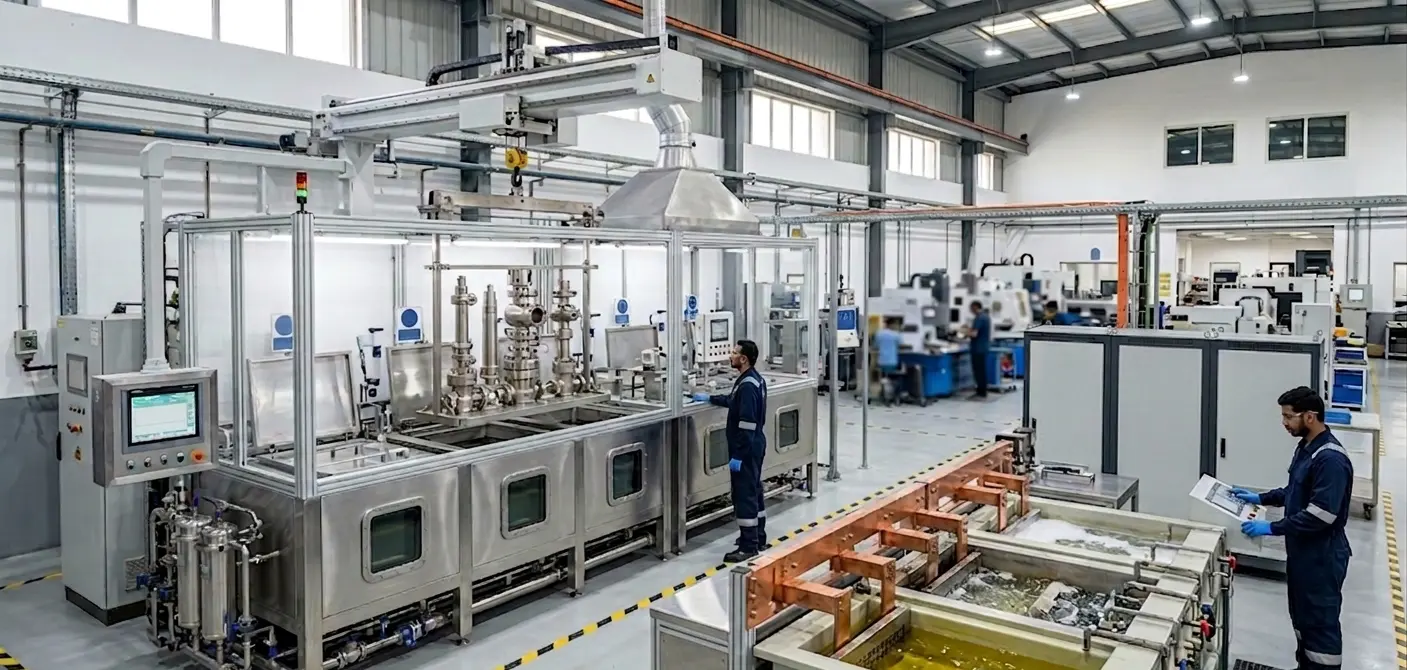
Electroless nickel plating is an autocatalytic chemical coating process that deposits a nickel-phosphorus alloy uniformly across every surface of a component, including internal bores, threads, undercuts, and blind holes, without any electrical current.
Unlike conventional electroplating, the ENP process uses a chemical reducing agent (typically sodium hypophosphite) to drive nickel ion deposition directly onto the substrate. Because the deposited nickel itself catalyses further deposition, the coating builds at the same rate everywhere, on edges, recesses, deep gun-drilled bores, and complex geometries equally. This is the property that makes ENP irreplaceable for oil and gas component geometry.
The ASTM B733 standard governs ENP for engineering applications, specifying thickness classes from 5 to 75+ microns and service condition grades aligned with corrosive environment severity.
ENP Phosphorus Grades, Why They Matter for Gulf Applications
The phosphorus content of the deposit is the most important variable for oil and gas specifications:
| Grade | Phosphorus % | Hardness | Corrosion Resistance | Best Application |
| Low phosphorus | 2–5% P | Highest (after HT) | Moderate | Wear-dominated applications |
| Mid phosphorus | 6–9% P | Balanced | Good | General oil & gas, valves, connectors |
| High phosphorus | 10–13% P | Moderate | Excellent | Sour service, offshore Gulf, H₂S exposure |
High phosphorus ENP produces an amorphous deposit with no crystalline grain boundaries, eliminating the boundary corrosion pathways present in lower grades. For UAE offshore and sour service applications, high phosphorus is the specification-correct choice, a requirement reinforced by NACE MR0175/ISO 15156 for H₂S-containing environments. Accurate Edge applies all three phosphorus grades from our Sharjah plating facility, matched to the project specification.

Key performance data:
- Coating uniformity: ±1 micron across all surfaces
- Salt spray resistance: 1,000–1,500 hours (high-P, ASTM B117)
- Hardness: 45–65 HRC as-deposited; up to 68 HRC after heat treatment
- Non-magnetic grades available for MWD and logging tool applications
- Compatible substrates: carbon steel, alloy steel, stainless, duplex, super duplex 2507, Inconel 625/718, aluminium, copper alloys
What Is Hard Chrome Plating? Process and Properties
Hard chrome plating uses electrical current to deposit a thick chromium layer from a hexavalent chromium bath, producing an extremely hard, wear-resistant surface primarily suited to abrasion and sliding friction applications.
Typical deposit thickness: 25–250 microns. Hardness: 68–72 HRC, harder than standard electroless nickel as-deposited. For hydraulic cylinder rods in continuous sliding contact against a seal, this hardness is hard chrome’s genuine and specific advantage.
The process limitations are physics, not workmanship. Electrical current follows the path of least resistance, edges and external high points plate thick, recesses plate thin, and internal bores receive minimal or no coverage. Post-plate grinding is standard on almost every hard chrome application. Micro-cracking develops during deposition, and in Gulf chloride environments those cracks act as corrosion initiation sites beneath an otherwise intact-looking surface.
Regulatory reality: Hexavalent chromium is a classified carcinogen under REACH and RoHS regulations. International oil and gas project specifications driven by European operators and IOCs are progressively mandating ENP substitution. If your project has a European tier-one operator in the supply chain, the direction of travel is clear.
ENP vs Hard Chrome: Complete Comparison for UAE Oil & Gas
1. Corrosion Resistance, Winner: ENP
The UAE operating environment is one of the most aggressive in the world for metal components: year-round salt-laden Gulf air, ambient temperatures above 45°C in summer, offshore chloride-rich seawater, and H₂S and CO₂ in many GCC applications.
- High phosphorus ENP: 1,000–1,500 hours ASTM B117 salt spray
- Hard chrome: 400–600 hours, partly because micro-cracking provides direct corrosion pathways to the substrate
In offshore and sour service applications, this gap is decisive. Surface treatment coating selection for Gulf-deployed components cannot ignore it.
2. Dimensional Uniformity, Winner: ENP
ENP deposits at ±1 micron uniformity across all surfaces. A component machined to 50.00mm comes out of the plating tank at 50.05mm with a 25-micron deposit, negligible variation around circumference, along the length, inside bores, and across threads. Most components hit final dimensional tolerance directly from the plating tank with no post-plate grinding required.
Hard chrome on the same component deposits unevenly, thick on edges, thin in recesses, minimal inside bores. Post-plate grinding is not the exception; it is the standard. On complex components, multiple grinding operations with dimensional checks are routine, adding cost, lead time, and rework risk. This is why precision machining for oil and gas engineers consistently prefer ENP for complex geometry.
3. Wear and Hardness, Winner: Hard Chrome
Hard chrome: 68–72 HRC. ENP as-deposited: 45–55 HRC. Heat-treated ENP: up to 68 HRC. For hydraulic cylinder rods in continuous sliding contact and external surfaces subject to direct abrasion, hard chrome is correctly specified. For the majority of oil and gas components where corrosion and dimensional stability dominate the failure mode, this hardness advantage rarely determines the specification.
4. Complex Geometry and Internal Bores, Winner: ENP (decisive)
ENP coats everything: deep gun-drilled bores, blind holes, threads, undercuts, cross-drillings, and internal passages, uniformly, without exception. Hard chrome physically cannot coat internal bores reliably. For a downhole tool body with a 200mm gun-drilled bore, threaded connections at each end, and multiple cross-drillings, ENP is not merely the preferred option. It is the only practical one. The ASM International surface engineering handbook identifies this geometry limitation as the primary technical driver behind the industry shift from hard chrome to ENP for complex component profiles.
5. Total Cost, Winner: ENP (when all steps counted)
ENP rate per square metre is sometimes quoted higher than hard chrome. That comparison ignores post-plate operations. Hard chrome almost always requires post-plate grinding, inspection, and often rework. On a complex valve body, post-plate machining can cost as much as the plating itself. ENP eliminates most of that. Total cost from machined part to finished coated component: typically 20–30% lower with ENP on complex oil and gas geometries, a finding consistent with data from TWI’s surface engineering cost studies.
6. Regulatory Compliance, Winner: ENP
ENP: compliant with API, ISO, NACE, no restrictions. Hard chrome: hexavalent chromium restricted under REACH and RoHS, with IOC and European operator specifications progressively mandating substitution across the GCC supply chain.
Full Comparison Table
| Criteria | Electroless Nickel Plating (ENP) | Hard Chrome Plating |
| Corrosion resistance | Excellent, 1,000–1,500 hrs salt spray | Good, 400–600 hrs |
| Coating uniformity | ±1 micron, all surfaces | Non-uniform, current-dependent |
| Internal bores & complex geometry | Full coverage, no limitations | Significant process limitations |
| Hardness (as-deposited) | 45–55 HRC (up to 68 HRC heat treated) | 68–72 HRC |
| Post-plate grinding | Rarely required | Almost always required |
| UAE Gulf environment suitability | Excellent | Moderate |
| Sour service / H₂S suitability | Excellent (high-P grade) | Limited |
| Regulatory status | No restrictions | Hexavalent Cr, REACH/RoHS restricted |
| Total cost (complex parts) | Lower | Higher with post-plate work |
| Best application | Valves, connectors, downhole tools | Hydraulic rods, high-abrasion external surfaces |
Real Applications Where ENP Is Specified in UAE Oil & Gas
Downhole tool mandrels and collars: Long gun-drilled bores for fluid passageways, wireline access, and pressure balancing in Inconel 718, L80, P110, and super duplex 2507. High phosphorus ENP applied after drilling andhoning on all wetted and external surfaces. The complete workflow, CNC machining → gun drilling → honing → ENP, runs in-house at Accurate Edge with no external transfers.
Valve bodies and seat bores: Complex internal geometry with H₂S exposure in production and injection service. Mid or high phosphorus ENP depending on sour service severity. Hard chrome physically cannot coat the internal bore geometry these components require.
Pump shafts and impeller housings: Corrosion combined with moderate wear in centrifugal and reciprocating pump assemblies. Mid phosphorus ENP delivers faster cycle time than hard chrome with its post-plate grinding requirement. Large part ENP capability at Accurate Edge accommodates the envelope sizes typical of UAE pump housing components.
Wellhead connectors and stab plates: Salt, H₂S, mechanical load, and temperature cycling in Gulf offshore environments. ENP on all wetted surfaces is standard in current GCC project specifications. ASTM B733 Class 5 or 6 is the typical reference.
Premium and VAM threaded connections: Thread profiles coated at uniform thickness for consistent make-up torque and seal performance. Hard chrome cannot coat threaded geometry consistently, ENP is the only viable option for critical threaded connections going into sour service.
When Hard Chrome Still Makes Sense
Hard chrome is still correctly specified for hydraulic cylinder rods in continuous sliding contact against a seal, external cylindrical surfaces where internal geometry does not need coating, and legacy project specifications not yet revised to permit ENP substitution. The question is never which coating is better in general, it is which failure mode you are protecting against, and whether the process can coat your geometry uniformly.
What to Ask an ENP Supplier in the UAE Before You Commit
1. Can they plate your component size? Tank dimensions define what is physically possible. Large part ENP for long mandrels and large valve bodies requires tanks most operations do not have. Confirm maximum component envelope before requesting a quote.
2. Is ENP applied in the same facility as CNC machining? Transport between machining shops and external platers introduces dimensional risk and handling damage. In-house ENP after CNC machining in UAE under one quality system is the standard for safety-critical components.
3. Are they API-certified? Oil and gas project specifications require documented quality systems across the supply chain. API Monogram certification covering both machining and coating under one roof removes the audit complexity of dual subcontracting.
4. Can they plate exotic alloys? Super duplex 2507, Inconel 625, Inconel 718, titanium. Not every ENP supplier has the bath chemistry and process control for these substrates. Confirm substrate compatibility before specifying.
5. Do they conduct NDT after plating? Coating that seals a crack beneath it is worse than no coating on a safety-critical component. Non-destructive testing in UAE, magnetic particle inspection (MPI) and liquid penetrant inspection (LPI) after plating, should be standard on any part going into oil and gas service. The British Institute of Non-Destructive Testing (BINDT) framework requires certified operators for safety-critical NDT; confirm operator certification before approving a supplier.
6. Which phosphorus grades do they offer? A supplier offering only one grade cannot comply with specifications requiring high phosphorus ENP in sour service. Grade flexibility is a direct competency indicator.
Frequently Asked Questions:
Q: What is the difference between ENP and electroplating?
ENP uses an autocatalytic chemical reaction, no electrical current. Conventional electroplating uses electrical current, which causes non-uniform deposition on complex geometries. ENP deposits uniformly on all surfaces including internal bores, threads, and undercuts, making it the correct process for complex oil and gas component geometry.
Q: What is high phosphorus electroless nickel plating used for in oil and gas?
High phosphorus ENP (10–13% P) is specified for sour service, offshore Gulf environments, and any application with H₂S or chloride exposure. The amorphous deposit structure eliminates grain boundary corrosion pathways and delivers the highest corrosion resistance in the ENP grade range. See NACE MR0175/ISO 15156 for sour service material requirements.
Q: How thick is electroless nickel plating typically applied?
Standard oil and gas specifications call for 25–75 microns, controlled by immersion time in the plating bath. Because ENP is uniform, the specified thickness is achieved consistently across all surfaces, bores, threads, and external features, without post-plate grinding.
Q: Can electroless nickel plating be applied to Inconel and super duplex?
Yes, with correct bath chemistry and substrate preparation. Accurate Edge regularly applies ENP to Inconel 625, Inconel 718, super duplex 2507, and most other alloys used in UAE oil and gas component manufacturing.
Q: Is electroless nickel plating allowed under API specifications?
Yes. ENP is permitted and referenced across multiple API standards for oil and gas equipment. The specific grade and thickness must comply with the referenced standard or project specification. Accurate Edge’s API Monogram certification covers ENP application within a documented quality system.
Q: What is the lead time for electroless nickel plating services in the UAE?
For components processed in-house at Accurate Edge’s Sharjah facility, typical lead time after machining is 2–5 working days depending on component size and specification. Sending components to external platers abroad adds 2–4 weeks minimum, a real cost for GCC project schedules.
Q: How does ENP compare to PTFE coating for oil and gas components?
ENP and PTFE serve different functions. ENP provides hardness, corrosion resistance, and dimensional build-up on metal substrates. PTFE coatings provide dry film lubrication and non-stick properties but have limited hardness. They are sometimes combined, electroless nickel with PTFE co-deposition, for applications requiring both corrosion resistance and lubricity.