
Manufacturing is the keystone of contemporary industry, transforming raw materials into an apparently endless number of finished goods. To appreciate the sophistication and accuracy of the things we consume every day, knowledge of the primary manufacturing processes is important.
In this blog, we discuss the 10 important manufacturing processes, how they operate and where the CNC manufacturing process takes centre stage.
What Are Manufacturing Processes?
Manufacturing processes comprise different techniques and approaches employed to create finished products out of raw materials. The manufacturing processes dictate the product’s strength, appearance, functionality and quality. Manufacturing is not a single entity; it consists of several specialized actions each of which is appropriate for certain materials, shapes and industries.
The 10 Essential Manufacturing Processes
Following are critical manufacturing processes that are instrumental in creating products.
1. Casting And Creating Intricate Metal Shapes
Casting is one of the earliest production techniques central to forming metals and alloys. Picture pouring molten metal into a mold created with the precise shape of your finished product. The mold is a temporary container permitting the molten material to cool and harden into an exact replica.
Step by Step Process:
- Pattern Making: A replica of the object (pattern) is made usually from wax or wood.
- Mold Making: Metal, ceramic or even sand molds are built around the pattern.
- Melting: Alloys like aluminium or also steel are melted at high temperatures.
- Pouring and Cooling: Molten metal is poured into the mold cavity which later solidifies.
- Shakeout and Finishing: Molds are crushed and the rough casting is cleaned, sometimes requiring additional machining.
- Uses: Engine blocks, turbine blades and heavy machinery parts take advantage of the cost-effective production of large and complex shapes through casting.
2. Shaping To Create Accurate Plastic Components
Whereas casting is concerned with metals, molding deals with plastics and polymers. Injection molding, the most popular molding process, entails melting plastic pellets into molten form and then injecting at high pressure into metal molds.
Detailed Procedure:
- Injection: Molten thermoplastic is injected into the mold.
- Cooling: Plastic rapidly cools within the mold.
- Ejection: Completed parts are ejected automatically.
- Uses: Consumer electronics cases, automotive interior panel components, medical device parts.
3. Materials of Forming Without Material Loss
Forming operations apply pressure to shape metals or plastics without removing material. This is important for producing structural components with increased mechanical strength.
Types & Information:
- Bending and Stamping: Metals are stamped or bent into form.
- Rolling: Metallurgy is rolled through rollers to decrease thickness or impart curves.
- Forging: Hammering or pressing under high pressure shapes metals usually hot in order to improve grain flow and toughness.
- Applications: Fuselage panels for aircraft, pipes and chassis for automobiles.
4. Machining for Accurate Cutting and Shaping
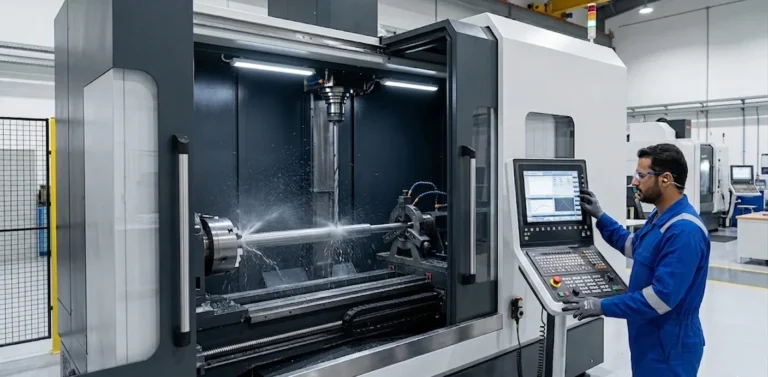
Machining cuts away excess material from a piece of work to get accurate shapes and surface finishes. It is important when the tolerance is high and geometries are intricate.
Process Insights:
- CAD models are converted to CAM programs that produce G-codes.
- Machining centres like lathes, milling machines and drills trace the toolpaths.
- Cutting data like speed, feed and depth are adjusted with high precision.
- Inspection guarantees precise dimensions and surface finish.
The method produces parts like gear shafts, valves and aerospace parts with micrometre tolerance.
5. Powder Metallurgy from Metal Powders
This sophisticated process produces parts from a mixture of metal powders pressed and heated to have particles stick together without melting completely.
Step by step:
- Powders made through atomization or electrolytic processes.
- Powders mixed with lubricants.
- Pressed into dies to form “green” parts.
- Sintered under controlled atmospheres at temperatures just below melting.
Advantages: Forms complex geometries with little waste and stringent material property control.
6. Treatment to Strengthen and Protect
Parts frequently receive treatment after shaping to improve performance:
- Heat Treatment: Methods like annealing and quenching alter hardness and also ductility.
- Surface Treatments: Methods like carburizing or even coating hardened surfaces or improving corrosion resistance.
Tool, gear and high-wear part applications require this stage.
7. Joining Parts to Build Assemblies
Manufactured parts do not usually work independently. They are joined by:
- Welding: Joining parts by melting them together.
- Brazing and Soldering: Joining with filler metals at lower temperatures.
- Mechanical Fastening: Rivets and screws provide permanent and removable assembly.
- Adhesives: Chemical bonds appropriate for fragile or even composite materials.
8. Assembly to Complete the Product
Assembly combines components into finished products through:
- Manual or automated processes according to complexity.
- Alignment, fastening and functional testing.
- Production lines choreographed with robotics and conveyors.
Applications in automobiles, electronics and appliances.
9. Layer by Layer Additive Manufacturing
Layer by layer additive manufacturing like 3D printing differs from conventional subtractive processes by fabricating components layer by layer from computer designs.
- Materials like thermoplastics as well as powders of metals or resins.
- Techniques like Selective Laser Melting and also Fused Deposition Modelling.
- Supports intricate internal geometries and quick prototyping.
Especially for low-volume, customized or complex parts.
10. Appearance and Durability Finishing
Appearance and durability finishing operations polish, coat or texture surfaces for durability and appearance like:
- Grinding and polishing to the smooth finishes.
- Painting or powder coating for protective corrosion and also appearance.
- Plating with metals like chrome for wear.
CNC Machining: The Pillar of Precision Production
Where does CNC machining find its place among this wide range of manufacturing operations? CNC machining is an automated subtractive technique under the category of machining but uniquely transformative.
Why CNC Machining Is Important:
Following are the reasons why CNC machining is important:
- Computer Control: Preprogramed computer instructions from CAD designs drive CNC machines with micron level precision.
- Multi-Axis Capability: CNC mills and lathes move tools on multiple axes in one motion making complex shapes possible.
- Material Versatility: Compatible with metals and plastics as well as composites from aluminium, oil and gas, aerospace components to titanium medical implants.
- Repeatability and Efficiency: CNC provides the same precision for thousands of parts with minimal human intervention.
- Integration with Modern Workflows: CNC machining often follows casting or forming stages for refinement or complements additive manufacturing by improving surface finish and critical dimensions.
Conclusion
Manufacturing encompasses several specialized procedures from classic casting to cutting-edge additive manufacturing. The CNC manufacturing process is essential by providing precision and efficiency. Accurate Edge is the leader in CNC machining offering precise as well as high-quality components that meet stringent industry standards. Our expertise facilitates smooth integration with other manufacturing processes to produce improved product quality and consistency
Frequently Asked Questions
1. What is CNC machining and why is it important?
CNC machining is a computer-controlled, subtractive manufacturing process that provides high precision in shaping metals, plastics, and composites. It’s crucial for producing intricate designs with repeatable accuracy, especially for industries like aerospace, automotive, and medical devices.
2. How does CNC machining differ from traditional machining?
Unlike traditional machining, CNC machining is fully automated, using pre-programmed computer instructions for precise control over the machining tools. This ensures consistent, high-quality results, reduces human error, and allows for complex, multi-axis shapes with minimal manual intervention.
3. Can CNC machining work with all materials?
Yes, CNC machining can handle a wide range of materials, including metals like aluminum, steel, and titanium, as well as plastics, composites, and even certain ceramics. It is highly versatile, making it suitable for industries like automotive, aerospace, and medical.