
A client called us last month. They were having challenges with their completion tools that were getting corroded and were affecting their efficiency. We suggested phosphating with Xylan 1052 coating , the tools came off clean. Job done.
Xylan Coating Applicator in Dubai
In a market where many workshops offer “PTFE spraying,” we pride ourselves in having the expertise, knowledge, capability and trained personnel that differentiates us from the others. It means our facility in Dubai Investment Park has been technically audited and verified.
- Verified Processes: Our surface preparation and curing cycles meet Clients and global standards.
- Genuine Chemistry: We use authentic Xylan and Xylar formulations, ensuring the performance matches the technical data sheets.
- Quality Control: Every batch is tested for film thickness, adhesion, and cure integrity, backed by full traceability documentation.
That is the simplest way to explain what Xylan coating does and why it matters in the UAE. But there is more to it than one story, especially if you are working in oil and gas, petrochemical, or heavy manufacturing where the environment here is genuinely brutal on unprotected metal. So let us go through the whole thing properly.
What Is Xylan Coating
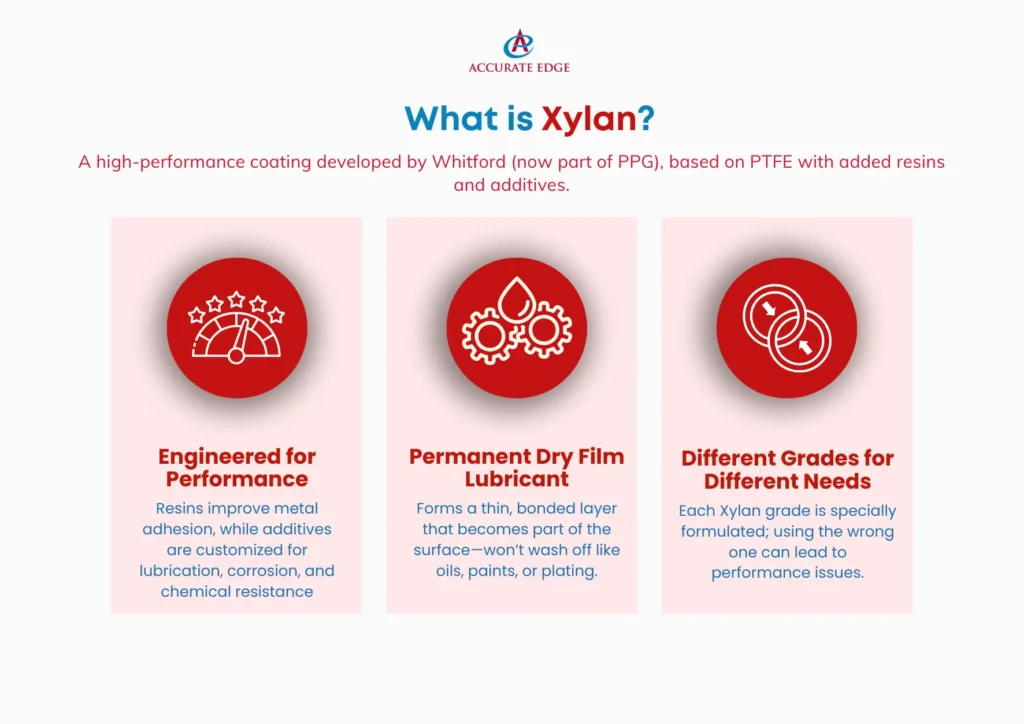
Xylan is a product made by Whitford, which is now part of PPG Industries. Whitford has been making it since 1969. The base chemistry is PTFE that Whitford takes and combines it with specific resins and additives, which is what makes Xylan different from a plain PTFE coating. The resins improve adhesion to metal surfaces, and the additive package is tuned to the specific performance requirements of each grade.
When it cures on a component, you get a thin bonded layer that acts as a permanent dry film lubricant. The lubrication is not sitting on top waiting to wash off. It is part of the surface itself. That is what makes it genuinely different from paint or plating.
Whitford makes a full family of Xylan grades and each one is formulated differently. Some lean into corrosion resistance, some into lubrication, some into chemical resistance, some into extreme pressure load bearing. They are not interchangeable. Using the wrong grade on the wrong application is a real problem, and it happens more than people realise when the applicator does not know what they are doing or is just spraying whatever they have on the shelf.
Why the UAE Makes This More Important Than Most Places
Most parts of the world can get away with simpler coatings. The UAE is genuinely one of the hardest environments on earth for metal components, and anyone who has worked here for a few years knows it.
Think about what metal components deal with here. Summer temperatures go above 45 degrees regularly. The Gulf pushes salt air onto every exposed surface year-round. Offshore, you add direct seawater spray. Then inside refineries and petrochemical plants you have H2S, CO2, chlorides, acids, and crude oil. Often all of that at the same time, on the same component.
Zinc plating lasts maybe 100 to 200 hours in a proper salt spray test. Xylan coating in the UAE goes up to 3,000 hours. In the field that gap is the difference between components that last years and components that need replacing every season.
We have seen it repeat itself constantly. A procurement team specifies coating on paper but goes with the cheapest and fastest option at the time. Six months later they are dealing with corroded fasteners, seized valves, and flanges that will not break apart. Then they call us.
This is also why if you pull out any major oil and gas project specification across the UAE or the wider GCC, Xylan is already written into it. It is not something engineers choose as a premium option. On most projects in this region it is simply the baseline requirement and has been for years.
Xylan Coating Grades: What Each One Is Actually For
Xylan 1070 – The Standard for Oil and Gas Fasteners
This is the one you see on stud bolts and nuts more than anything else in oil and gas applications across the UAE. It is solvent-based, goes over zinc or phosphate pre-treatment, and gives you up to 3,000 hours of salt spray resistance. Temperature range is minus 195 up to plus 260 degrees Celsius continuously, with an intermittent range up to 285. Film thickness sits at 20 to 25 microns so it does not affect tolerances on machined components.
It comes in a wide range of colours, which is more operationally useful than it sounds. Offshore platforms use colour-coded Xylan-coated fasteners to identify material grade, pressure class, and service location at a glance. During a turnaround when teams are moving fast and fatigued, that colour coding prevents the kind of mistakes that are expensive to fix.
Xylan 1424 – The Modern Low-VOC Replacement
Most new project specifications in this region have moved to 1424 as the default. The reason is environmental compliance. Xylan 1424 is waterborne and low-VOC, which passes the restrictions that 1070 does not on newer major projects. Corrosion resistance and torque performance are comparable to 1070. Operating range is minus 20 to plus 180 Celsius continuously, up to 230 intermittently.
If you are specifying a new build project right now and you are still calling up 1070 without checking the environmental requirements, you may need to revisit that.
Xylan 1425 – For High-Pressure Bearing Surfaces
This grade adds MoS2 into the formulation alongside PTFE. That gives it significantly better load-bearing capacity than the standard grades. We specify it for bearing surfaces, sliding fits, and downhole tool components where 1070 or 1424 would eventually break down under load. It handles bearing pressures up to 10,500 kg per square centimetre. Film thickness is 15 to 20 microns.
Xylan 1427 – Built for Subsea and Immersion Service
Designed specifically for prolonged subsea exposure. If a component is going underwater and staying there for years, 1427 is what maintains its corrosion resistance and torque control properties long after other grades start to break down. Subsea bolting and structural connectors are the main application.
Xylan 1052 – Extreme Pressure General Purpose
Solvent-based, high-temperature general-purpose grade for extreme pressure applications up to 150,000 PSI. Typically used on bearings, sealing rings, and valve springs. Continuous operating range from minus 195 to plus 260 Celsius.
Xylar Ceramic Coatings
Where abrasion resistance and higher-temperature performance are the priority rather than lubrication, Accurate Edge applies Whitford’s Xylar ceramic coating range. These are specified in aerospace and defence applications and on heavy industrial machinery running at temperatures above the Xylan ceiling. Xylar coatings are also often used as a primer base under a Xylan topcoat on applications where both corrosion resistance and thermal protection are needed.
What Xylan Coating Does in Practice
Anti-Galling Coating for Fasteners in UAE Oil & Gas
Galling is when thread surfaces cold-weld together under load. It happens on stainless to stainless connections, on exotic alloy fasteners, on any high-stress bolted joint that has been sitting in a corrosive environment for years. When it goes wrong you are cutting studs out of flanges, and that is slow, expensive, and dangerous during a live turnaround.
Xylan keeps a low-friction film between thread surfaces so they slide instead of weld. It also gives you predictable, repeatable torque during assembly, which matters directly for joint integrity on high-pressure connections. This is the single biggest reason anti-galling coating for fasteners UAE comes up so often in maintenance engineering conversations in this region.
Removes the Re-Lubrication Cycle
Because the lubrication is bonded into the surface, there is nothing to re-apply. No re-greasing, no contamination risk from lubricant migration into process streams, no maintenance call in a hard-to-access location offshore. That is real cost and real time saved over the service life of a component.
Handles the Chemistry
H2S, CO2, chlorides, most acids, most alkalis, most hydrocarbons. Xylan is chemically inert to almost everything you find in oil and gas and petrochemical environments. That is why it gets specified inside valve bodies and pump internals where the coating is in contact with process fluid continuously. A standard paint or plating would not survive that.
Temperature Range from Cryogenic to High Heat
Minus 195 to plus 260 Celsius continuously. We have coated components that end up in LNG cold boxes and components that end up adjacent to fired heaters. Both within the same Xylan grade family.
Colour Coding for Field Safety
Colour-coded Xylan-coated stud bolts are standard practice on offshore platforms in the GCC for identifying material grade, pressure class, and service type. It sounds simple, and it is, but it prevents errors during maintenance that would be costly to fix.
Industries That Specify Xylan Coating in the UAE
- Oil and gas, onshore and offshore – Stud bolts and nuts for high-pressure flanges, gate valve stems, subsea connectors, pipeline fittings, wellhead components. This is the bulk of what we coat and it is what most project specs in this region call for.
- Petrochemical and downstream – Reactor fasteners, heat exchanger bolting, pump and compressor components, instrumentation fittings. Anywhere aggressive chemical exposure makes standard coatings impractical.
- Water and utilities – Valve components and pipeline fittings in seawater, treated water, or chemically aggressive soil conditions.
- Aerospace and defence – Precision components needing tight-tolerance dry lubrication and temperature resistance, usually to Xylar grade specifications.
- General engineering and manufacturing – Any component where long-term corrosion protection or anti-galling performance is needed without ongoing maintenance.
Xylan vs Other Coatings: A Direct Comparison
| Coating | Salt Spray Resistance | Lubrication | Chemical Resistance | Temperature Range | Anti-Galling | Colour Options |
| Xylan 1070/1424 | Up to 3,000 hours | Excellent dry film | Excellent | -195°C to +260°C | Yes | Wide range |
| Zinc Plating | 100 to 200 hours | Poor | Poor | Limited | No | Limited |
| Molybdenum Disulfide | Moderate | Excellent | Moderate | -195°C to +400°C | Yes | No |
| Electroless Nickel Plating | High | Moderate | Good | Up to 260°C | Partial | No |
| Phosphating | Low to moderate | Poor | Moderate | Limited | No | No |
For our service and downhole tools we often apply Molybdenum Disulfide coating as part of a dual-coat system alongside Xylan. Both are done in house at our Dubai facility.
Frequently Asked Questions About Xylan Coating in the UAE
1. What is Xylan coating and what is it used for in the UAE?
Xylan is a fluoropolymer-based dry film lubricant coating made by Whitford, now part of PPG. In the UAE it is primarily used on oil and gas fasteners, valve components, subsea connectors, and pipeline fittings where corrosion resistance, anti-galling, and dry lubrication are required. It is a standard specification on most major oil and gas projects in the UAE and GCC.
2. What is the difference between Xylan and PTFE coating?
PTFE is the base polymer. Xylan coating is Whitford’s formulation that combines PTFE with specific resins to bond it properly to metal surfaces and tune the performance for industrial applications. A straight PTFE coating and a Xylan coating are chemically related but they are not the same product in practice.
3. What is the difference between Xylan and Xylar?
Xylan is fluoropolymer-based, built for corrosion resistance and dry film lubrication. Xylar ceramic coating is ceramic-based, built for abrasion resistance and higher-temperature performance in aerospace and defence applications. Both are Whitford products. Accurate Edge applies both.
4. What is the difference between Xylan 1070 and Xylan 1424?
Xylan 1070 is solvent-based and is the traditional standard for oil and gas fasteners. Xylan 1424 is waterborne and low-VOC, developed to meet environmental compliance requirements on newer projects. Performance is comparable for most applications. If your project specification has VOC restrictions, 1424 is the grade to use. Most new project specs in the GCC now default to 1424.
5.How thick is Xylan coating?
Typically 20 to 25 microns depending on grade. That is thin enough that machined tolerances on precision components are not affected when applied correctly.
6. Can Xylan be applied to stainless steel, duplex, super duplex, and exotic alloys?
Yes. The pre-treatment and primer system is adjusted depending on the substrate. Accurate Edge coats components in carbon steel, stainless, duplex, super duplex, Inconel, and other exotic alloys regularly as part of our combined CNC machining and coating service.
7. How long does Xylan coating last in offshore UAE conditions?
When correctly applied and used within its specified temperature and chemical exposure limits, Xylan lasts the full service life of the component. The three things that shorten coating life are poor surface preparation, wrong film thickness, and exceeding the operating limits of the grade. In offshore UAE conditions, correctly applied Xylan 1070 or 1424 on fasteners will typically outlast the maintenance cycle of the equipment it is on.
8.Is Xylan 1424 environmentally compliant?
Yes. Xylan 1424 is waterborne and low-VOC specifically to meet environmental compliance requirements that restrict solvent-based coatings on major oil and gas projects.
9. What industries use Xylan coating in Dubai and the UAE?
The primary users in the UAE are oil and gas operators, EPC contractors, petrochemical plants, and engineering and manufacturing companies. Xylan is also used in aerospace and defence, water and utilities, and general industrial manufacturing. Learn more about all coating services at Accurate Edge.
10. Where can I get Xylan coating services in Dubai?
Accurate Edge operates an approved coating facility in Dubai Investment Park 1. We apply the full range of Xylan and Xylar grades for oil and gas, petrochemical, and industrial clients across the UAE and GCC. Contact us at +971 4 8858090 or info@accurateedgeuae.com.
Why Accurate Edge for Xylan Coating in the UAE
Beyond the approval, we are a complete precision machining and coating facility on one site in Dubai Investment Park. Components machined in our CNC shop move directly to coating. No third party, no transit, no handling risk on precision-tolerance safety-critical parts.
We have been doing this since 2007. API Monogram licensed under 5B, 6A,7-1 , 7-2 and ISO 9001:2015 certified. 400 plus people, 140 plus machines, 3 facilities. We work with some of the largest oil and gas operators in the MENA region. We have not lost a client since we started.
If you have a project coming up, a turnaround to plan, or a coating problem you keep dealing with, get in touch. We will tell you which grade is right, give you a lead time, and quote you directly.