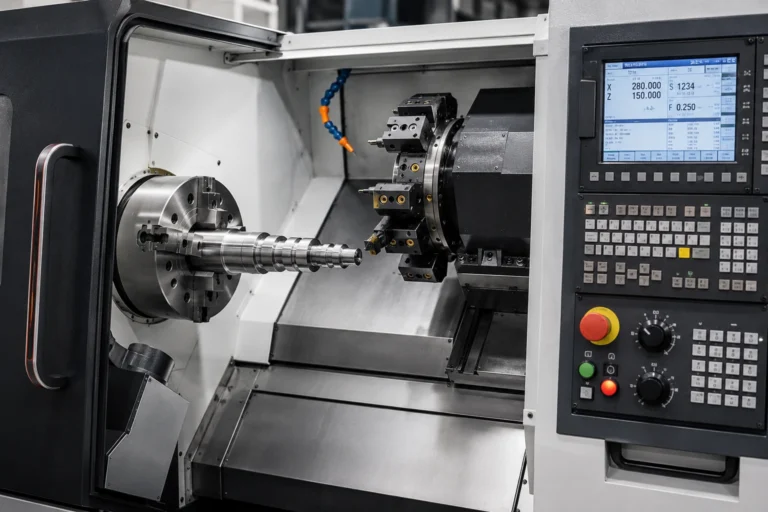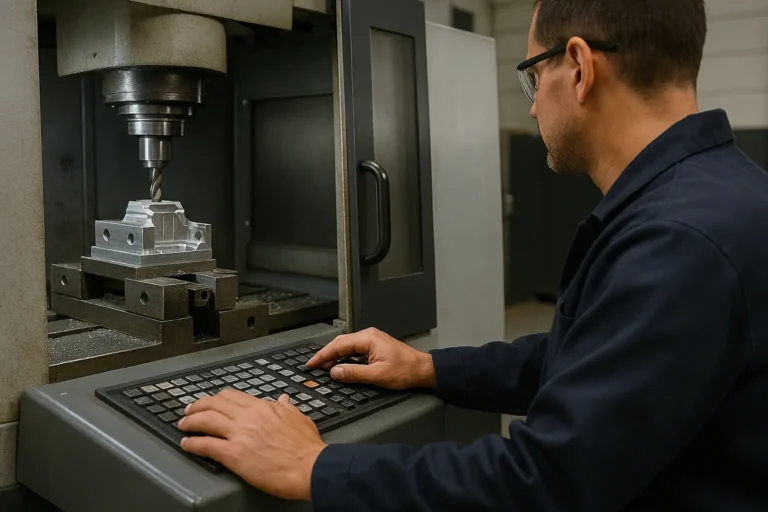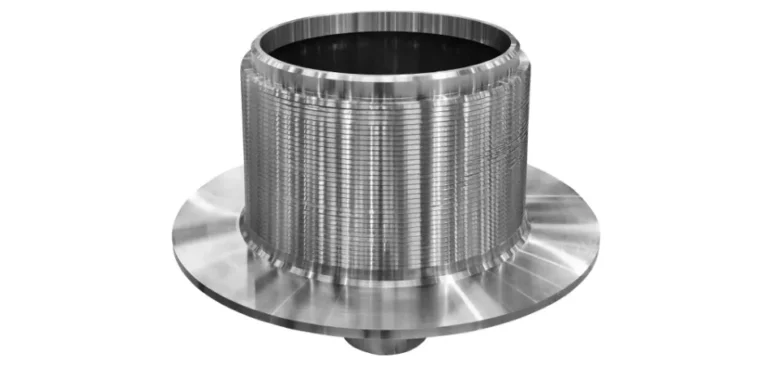
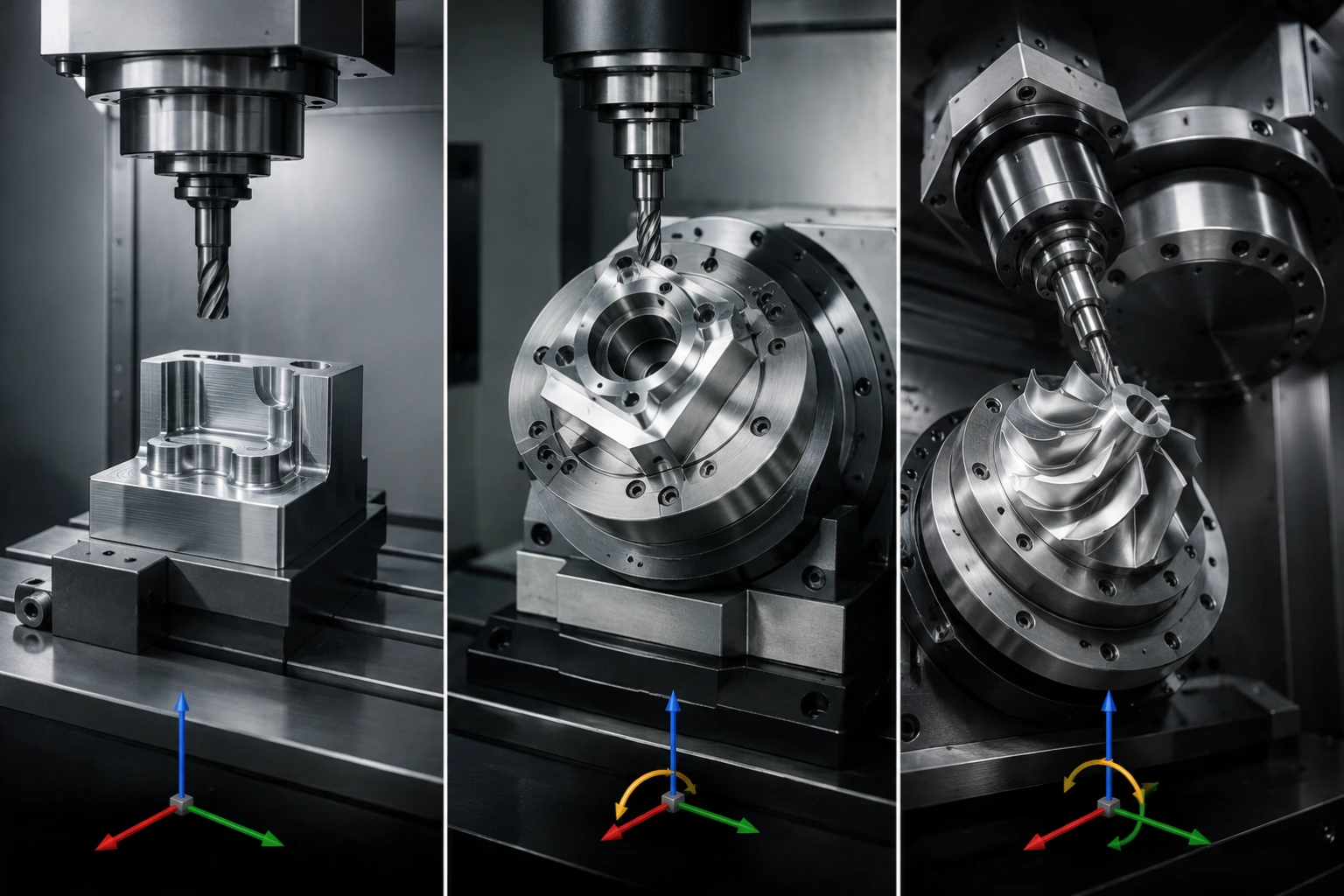

The primary distinction in the comparison of 3 axis vs 4 axis vs 5 axis CNC machining dictates the simultaneous directional movement of the cutting tool and workpiece. While 3-axis systems provide highly efficient planar milling across the X, Y, and Z axes, 4-axis and 5-axis platforms integrate rotational axes. This advancement enables the precise fabrication of highly complex, multi-sided geometries in a single setup, significantly enhancing dimensional accuracy for critical components.
At a Glance: Axis Configurations
| Machining Axis | Movement Capability | Primary Engineering Advantage | Typical Applications |
| 3-Axis CNC | X, Y, Z (Linear) | Optimal cost-efficiency and rapid setup for planar geometries. | Mounting brackets, base plates, standard flanges. |
| 4-Axis CNC | X, Y, Z + A (Rotational) | Continuous machining of cylindrical profiles. | Shafts, custom drill collars, tubular components. |
| 5-Axis CNC | X, Y, Z + A/B + C (Multi-rotational) | Uncompromising single-setup precision (Done-in-One). | Impellers, aerospace housings, API wellhead valves. |
The Fundamentals of CNC Axis Configurations
CNC machining operates on a Cartesian coordinate system, in which the cutting tool and workpiece are positioned relative to three linear axes. Beyond these three linear axes, advanced machining platforms introduce rotational axes, designated A, B, and C.
Core coordinate system:
- X-axis: Horizontal linear movement.
- Y-axis: Depth-oriented linear movement.
- Z-axis: Vertical linear movement.
- A-axis: Rotational movement around the X-axis.
- B-axis: Rotational movement around the Y-axis.
- C-axis: Rotational movement around the Z-axis.
The integration of one or more rotational axes fundamentally changes how a component is positioned relative to the cutting tool during a machining cycle. The engineering significance of rotational axes extends beyond geometric complexity alone:
- Each time a workpiece is removed from a fixture and repositioned for a subsequent operation, a new opportunity for positional error is introduced.
- These cumulative errors, referred to as stack-up tolerances, compound with every manual repositioning event.
- By enabling a component to be machined from multiple orientations within a single setup, rotational axes directly mitigate the risk of human error and reduce tolerance stack-up.
The classification of a machining platform as 3-axis, 4-axis, or 5-axis is therefore not simply a measure of mechanical sophistication, but a direct indicator of the achievable relationship between setup count and positional accuracy. As the number of controlled axes increases, the machine’s capacity to hold tight tolerances across multiple, interdependent features within a single component increases correspondingly.
3-Axis CNC Machining: Core Applications and Efficiencies
Operational Mechanics
A 3-axis CNC platform moves the cutting tool along three linear axes simultaneously, executing material removal on a single, fixed plane relative to the workpiece. The component remains stationary while the spindle traverses the X, Y, and Z axes to achieve the programmed toolpath.
Engineering Advantages
- Delivers exceptional efficiency and rapid programming times for components that require surfacing, slotting, and tapping operations confined to a single plane.
- Reduced kinematic complexity translates directly into shorter programming cycles and lower per-part machining costs.
- Provides faster turnaround for high-volume production runs.
- Remains the most cost-effective and operationally efficient manufacturing method for geometries that do not require multi-sided access.
Optimal Use Cases
- Enclosures
- Heavy structural plates
- Components with uniform depth profiles
- Standard mounting brackets and base plates
These part geometries do not demand access to multiple faces within a single operation, allowing the inherent efficiency of the 3-axis platform to be fully utilized without compromising on dimensional requirements. For manufacturers evaluating machining strategy on the basis of project economics, 3-axis platforms typically represent the lowest capital and operational cost within a CNC fleet.
4-Axis CNC Machining: Advanced Cylindrical Capabilities
Operational Mechanics
4-axis CNC machining introduces the A-axis, permitting the workpiece to rotate on the X-axis while milling operations occur concurrently. This rotational capability allows the cutting tool to engage the component from a continuously changing angular position without requiring the part to be unclamped and repositioned.
Engineering Advantages
- Facilitates continuous machining around a cylinder, ensuring exacting concentricity.
- Eliminates the need for secondary setups on components with features distributed around a circumference, such as radial holes, keyways, or helical profiles.
- Maintains a fixed datum throughout the operation, preserving positional accuracy between features.
- Supports indexed positioning, in which the A-axis rotates the workpiece to a fixed angular position before a discrete milling or drilling operation is performed.
Optimal Use Cases
- Complex threading operations on oilfield tubulars
- Camshafts
- Custom cylindrical assemblies
- Flanges with radially distributed bolt patterns
Components that combine a primarily rotational geometry with secondary machined features are ideal candidates for this configuration, as it balances the efficiency of a simpler kinematic system with the precision benefits of continuous rotational access.
5-Axis CNC Machining: Multi-Sided Precision and Complex Geometries
Operational Mechanics
5 axis CNC machining Dubai operations enable simultaneous movement across five distinct axes, allowing the cutting tool to maintain a continuous, optimal engagement angle with the workpiece throughout the machining cycle. This configuration combines the three linear axes with two rotational axes, most commonly a combination of A/B and C, granting the spindle and workpiece the ability to articulate relative to one another across nearly the entire surface of a component.
Engineering Advantages
- Represents the premier solution for achieving strict Geometric Dimensioning and Tolerancing (GD&T) requirements.
- Maintains a continuous, optimized approach angle to the cutting surface.
- Maximizes tool life through optimized feed angles and reduced cutting forces.
- Delivers superior surface finishes on exotic alloys that are otherwise difficult to machine.
- Eliminates the positional inconsistencies inherent to multi-setup manufacturing, since up to five faces of a component can be accessed within a single setup.
This capability is of particular importance for facilities providing 5 axis CNC machining Dubai services to high-specification aerospace and energy sectors.
- Parts defined by a dominant rotational axis, such as shafts or tubular assemblies, are efficiently produced on 4-axis equipment.
- Components exhibiting complex, non-rotational contours, such as impeller vanes or valve bodies with intersecting flow paths, require the additional articulation of a 5-axis platform to achieve accurate results.
Determining the Best CNC Machining Process for Oil and Gas Parts
Selecting the best CNC machining process for oil and gas parts requires a rigorous assessment of component function, operating pressure, and geometric complexity.
High-Pressure Valves & BOPs
5-axis machining is the definitive choice for Blowout Preventers and multi-port API valves:
- The single-setup process guarantees exact alignment of internal flow channels and sealing faces.
- This is a critical requirement for components subjected to high-pressure, high-consequence service conditions.
- Any misalignment between sealing surfaces and flow paths introduces risk to system integrity, making the positional accuracy delivered by 5-axis machining a non-negotiable specification.
Downhole Tools & Drill Collars
4-axis machining is highly effective for long, continuous cylindrical components used in drilling applications:
- Downhole tools and drill collars typically require consistent concentricity along an extended length.
- Secondary features, such as threaded connections or fluid channels, are addressed efficiently through the rotational capability of a 4-axis platform.
- This approach avoids the added kinematic complexity a 5-axis setup would introduce for a predominantly cylindrical geometry.
In both applications, the governing selection criterion remains the same. The axis configuration must correspond to the geometric and tolerance demands of the component’s function in service, as Oil and Gas components operate under conditions where dimensional deviation carries direct consequences for system integrity.
Selecting an Elite CNC Machining Company in Dubai
Identifying a qualified CNC machining company in Dubai for high-integrity Oil & Gas or aerospace applications requires verification of specific operational and quality prerequisites.
Certifications
- Strict adherence to API Q1 and ISO 9001:2015 quality management systems.
- A documented, auditable framework for process control, traceability, and continuous improvement.
- This represents a baseline requirement for suppliers serving regulated energy sector applications.
Integrated Capabilities
- The ability to execute 5-axis machining alongside in-house Non-Destructive Testing (NDT).
- In-house specialized coating applications.
- Reduced logistical complexity, shorter lead times, and a single point of accountability for component quality throughout the production cycle.
Material Expertise
- A proven track record in machining high-tensile materials such as Super Duplex, Inconel, and Titanium.
- Specialized tooling strategies, feed rates, and coolant application to address work hardening and reduced thermal conductivity.
- The ability to machine successfully without compromising material properties or dimensional accuracy.
Read More Here: how to choose the right CNC machining partner?
Consult with Accurate Edge UAE
Determining the optimal machining strategy is critical to component performance and project economics. We invite procurement directors and lead engineers to submit technical drawings to Accurate Edge UAE. Our engineering team will evaluate your specifications and recommend the most efficient, high-integrity CNC machining process for your requirements.
FAQs: 3-Axis vs 4-Axis vs 5-Axis CNC Machining
What is the main difference between 3-axis and 5-axis CNC machine capabilities?
The primary difference is that a 3-axis machine moves a cutting tool along three linear directions (X, Y, Z), which requires manual repositioning for multi-sided parts. A 5-axis machine adds two rotational axes to accurately machine five sides of a complex component in a single setup.
Why is 5-axis CNC machining in Dubai specified for aerospace and energy components?
5 axis CNC machining services are specified for these sectors because the process facilitates the precise fabrication of highly complex geometries, such as turbine impellers and API valves, while eliminating the dimensional alignment errors associated with multiple manual setups.
How do engineers determine the best CNC machining process for oil and gas parts?
Engineers select the process based on component geometry. 4-axis machining is optimal for cylindrical downhole tools, while 5-axis machining is the standard for complex pressure control equipment that requires absolute positional accuracy and superior surface finishes.