
There is a part sitting inside almost every machine, vehicle, and structure around you right now. Flat faces. Drilled holes. Internal pockets. Surfaces that had to come out perfectly flat or the whole assembly would never fit together.
Nobody hand-files those surfaces to size. A CNC milling machine made them.
If you work in manufacturing, procurement, or engineering anywhere in the UAE, you are already paying for this process, even if nobody has explained what it actually involves. So here is the full picture.
What is CNC Milling?
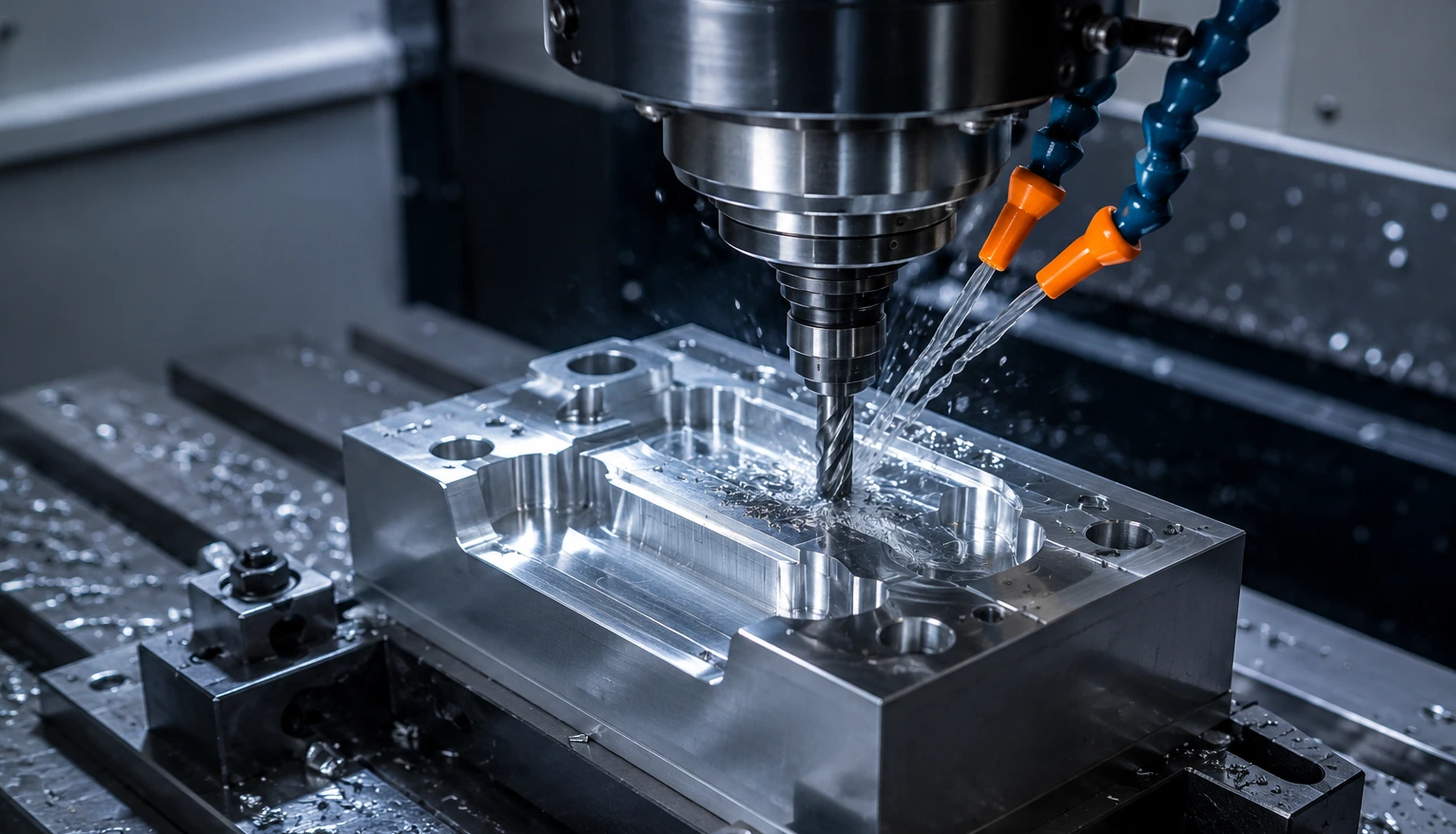
CNC milling is a CNC machining method where a rotating cutting tool travels across a fixed piece of material and removes whatever is not part of the final shape.
The raw material gets clamped onto a table. The cutter spins fast and moves across the surface, along straight lines, curves, or layered 3D paths, taking material away bit by bit until what is left matches the drawing exactly.
CNC stands for Computer Numerical Control. That simply means the toolpath is run by a computer, not guided by hand. Every move, every depth, every speed setting is loaded into the program ahead of time. Part one and part five hundred follow the exact same script.
That repeat-ability is really the entire reason this process exists.
What is a CNC Mill?
A CNC mill is the machine doing the work. A spindle up top, a worktable underneath, a control panel running the show. Sounds basic. In reality, today’s machines do a lot more than that description suggests.
Picture a three-axis setup first, since that is the foundation. Movement along X, Y, and Z. Side to side, front to back, up and down. That alone covers most flat and box-shaped parts.
But walk into a modern shop and you will find machines doing far more. Tool changers swapping through thirty or more cutters mid-job without stopping. Coolant blasting at high pressure to clear chips from deep cavities. On-machine probes checking the part and adjusting offsets without anyone touching the controls.
A well-built CNC milling machine is built to catch its own mistakes before they ever reach you.
How Does CNC Milling Work?
It begins with a drawing and ends with a finished component. Here is the path between the two.
Programming happens first: Someone takes your CAD file or engineering drawing and builds out the cutting strategy in CAM software. Tool choices, cut depths, pass order, all of it gets locked in before anything touches the machine. This becomes G-code, the instruction set the controller reads.
Setup decides everything else: The block of material gets locked onto the table, either in a vice, with clamps, or on a custom fixture built for that specific part. A loose setup means a part that shifts mid-cut, and a part that shifts mid-cut is a part headed for the scrap bin.
Roughing happens before anything fine: This stage is about clearing material fast. Heavier cuts, aggressive feeds, getting the block down to something resembling the final shape.
Finishing is where the real accuracy comes from: Slower, lighter, sharper. This is the stage that decides whether a tight tolerance gets met or missed.
Inspection closes the loop: Every dimension on the drawing gets checked against the actual part using micrometers, CMM equipment, or surface testers. For oilfield and aerospace work across the UAE, this data becomes a report that travels with the shipment.
Sandvik Coromant’s milling resource hub goes much deeper into cutting parameters if you want the engineering side of this. For a full breakdown of every stage, our CNC milling process page covers it step by step.
Types of CNC Milling Machines:
Machine type sets the boundaries of what you can produce, how many separate setups a job needs, and what it costs to get there.
Vertical machining centre: Spindle pointing straight down toward the table. The standard configuration in most workshops. Strong choice for flat work, pockets, drilled holes, and contoured top surfaces. Most everyday precision work across Dubai runs through one of these.
Horizontal machining centre: Spindle lying on its side. Workpiece sits on a rotary pallet that can flip the part around mid-cycle. Better suited to heavy stock removal and parts that need several faces machined without manual repositioning.
5-axis machining centre: Adds two rotational movements on top of the standard three linear ones. The cutter can approach a surface from almost any angle without unclamping the part. This is the territory of aerospace components, turbine geometry, and intricate mould work. Genuine 5-axis capability is not universal across UAE shops, and the ones that have it tend to price accordingly.
Bed mill: Worktable handles the X and Y movement, spindle handles Z. Built rigid, suited to large, heavy stock that is awkward to move around.
Gantry mill: A bridge structure spans an oversized fixed table. Used for big components, structural sections, large moulds, marine parts, anything too big to chase around a smaller machine.
Vertical centres cover the day-to-day jobs. Horizontal centres step in for volume work. The 5-axis takes over when geometry gets complicated and re-setups would introduce risk. Our types of CNC milling machines guide goes deeper into each configuration.
What Materials Can Be CNC Milled?
Quite a broad list, honestly. Here is what shows up most often on UAE shop floors.
Aluminum leads on speed. It cuts fast, tools last longer on it, and cycle times stay short. Common across aerospace structural work and anywhere weight is a real concern.
Stainless 304 and 316L turn up constantly. 316L specifically wherever seawater, chemicals, or food contact is involved. Slower to machine than aluminium, but very manageable with proper tooling and coolant strategy.
Mild steel and tool steel cover structural and wear-resistant applications. Inconel and titanium step in for high heat, high pressure work in oilfield and aerospace settings. Both are costly to machine, and that cost makes mistakes expensive in a way that aluminium scrap never is.
Plastics like Nylon, POM, PEEK, and PTFE are all workable too, common in medical components, electrical insulators, and food-grade parts.
Material choice drives lead time, tooling cost, and price per part more than people expect. The ASM International materials database is a solid place to start comparing alloy properties. For UAE-specific guidance, see our CNC milling materials page.
CNC Milling vs. CNC Turning
Short version, they solve different problems, and a lot of real parts need both. Both are core CNC machining processes, just built for opposite kinds of geometry.
CNC turning spins the workpiece itself. Built for round geometry, shafts, bushings, threaded fittings, nozzles. Quick, accurate, well suited to anything cylindrical.
CNC milling keeps the workpiece still and spins the tool instead. This is where flat faces, pockets, slots, and complex contours come from. Geometry is not limited to round shapes here.
A valve body is a good real-world example. The bore through the centre comes from a turning operation. The mounting face and bolt pattern come from milling. Turn-mill machines combine both in a single setup now, which avoids the alignment risk that comes with shifting a part between two separate machines. Our CNC milling vs CNC turning comparison covers this in more depth.
Advantages of CNC Milling
Shape flexibility: Almost anything that can be drawn can be milled. Flat panels, contoured surfaces, internal cavities, angled faces, layered 3D forms. The drawing sets the limit, not the machine.
Tight tolerances: Sub-0.01 mm accuracy is routine on a well-maintained machine. In aerospace and oilfield work, that level of precision is simply expected, not a selling point.
Run-to-run consistency: Whether it is the first part or the thousandth, the program does not get tired, distracted, or inconsistent the way a human operator eventually does.
Surface quality: A properly set finishing pass lands in the Ra 0.8 to 1.6 µm range without extra work. Push the parameters further and Ra 0.4 µm is achievable without sending the part out for grinding.
Cost scaling: One program covers a single prototype or a thousand-unit production run. Setup cost stays fixed regardless of volume, so cost per part drops as quantity climbs.
Fewer setups on complex parts: 5-axis capability cuts down on repositioning, which means fewer chances for alignment error on geometrically demanding components.
Why CNC Milling Matters in UAE Manufacturing
Dubai and the broader UAE run on energy infrastructure and large-scale construction, and that demands a serious level of machining capability behind the scenes.
Oil and gas drives the largest share of demand. Valve bodies, manifold blocks, pump housings, mounting plates, custom flanges, all of it needs tight tolerances, traceable materials, and paperwork that backs it up, often built against API standards that oilfield components are expected to meet. A wellhead assembly does not get the benefit of “close enough.”
Aerospace maintenance is expanding steadily too. Dubai’s role as an aviation hub means aircraft routinely come in for servicing, and servicing pulls machined components, brackets, housings, structural pieces, all built against aerospace-grade drawings with full traceability.
Construction and MEP projects across the country regularly need one-off mechanical parts that nobody stocks off the shelf. Anchor plates, custom brackets, bespoke fittings, this is steady, recurring demand.
Defence and marine sectors add their own share too, enclosures, structural components, fittings built for harsh saltwater environments.
CNC milling in UAE through a shop like Accurate Edge UAE means certified material, complete dimensional documentation, and timelines that actually match the pace projects move at here. Reach out and we will get a quote back quickly.
Common CNC Milling Defects and How to Avoid Them
Solid process discipline is what keeps defects out of a job in the first place. Worth knowing what causes the common ones so you can ask better questions of your supplier.
A rough surface finish almost always points back to a tired cutting tool, a spindle speed that does not match the material, or a finish pass run too aggressively. Swapping the tool and dialling in the right parameters usually solves it.
Parts coming out slightly off-dimension are often the result of heat building up across a long run, gradual tool wear, or an offset that was entered wrong at setup. In-process checks and wear compensation in the controller catch this before it spreads through a batch.
That rippled, wavy texture you sometimes see comes from vibration between the cutter and the workpiece. Excess tool overhang, a clamp that is not quite rigid enough, or mismatched cutting parameters usually sit behind it. Tightening up the setup and adjusting speeds and feeds clears it.
Sharp little edges left where a cut ended are a sign that the toolpath was not planned with deburring in mind. Building edge-breaking moves directly into the program handles this far better than relying on someone with a file afterward.
And if a part shifts mid-cut, the clamping was not strong enough for the job. That is a setup-stage fix, not something you patch after the part has already gone wrong.
A capable CNC milling service runs first-article checks on new jobs and keeps measuring throughout production runs. If a supplier skips this, every batch is a bit of a gamble.
Frequently Asked Questions:
What is CNC milling?
Picture a block sitting bolted to a table, not moving an inch. A cutter comes down, spinning fast, and starts tracing a path across it, following instructions a computer wrote out in advance. That is CNC milling in a nutshell. Turning flips this setup entirely, there the workpiece is the one spinning and the tool barely moves. Milling keeps the part anchored and lets the cutter do all the travelling instead.
What is a CNC mill?
A CNC mill is the machine running this process, built around a spindle, a worktable, and a controller executing the cutting program. Machines range from straightforward 3-axis vertical setups right up to full 5-axis units capable of cutting nearly any shape in one clamping.
How does CNC milling work?
A CAD drawing gets turned into a cutting program through CAM software, and that program directs the tool’s movement through roughing and finishing stages until the part matches spec. Our CNC milling process page walks through each stage in full.
What are the types of CNC milling machines?
Vertical centres, horizontal centres, 5-axis machines, bed mills, and gantry mills, each one fitting different part sizes and production needs. The types of CNC milling machines page breaks down where each one fits best.
What are the advantages of CNC milling?
Wide geometric range, tight and repeatable tolerances, strong surface finish quality, and the ability to scale from a single prototype to large production batches of one unchanged program.
What is the difference between CNC milling and CNC turning?
Here’s the easiest way to remember it. On a lathe, you are the one standing still while the part does all the moving. On a mill, it flips, the part stays put and the cutter does the travelling. That single difference is why turning is your go-to for anything round, a shaft, a bushing, a threaded pin, while CNC milling takes over the moment your part needs a flat face, a pocket, or a shape that has nothing to do with a circle. Plenty of components need both processes together. Our CNC milling vs CNC turning page lays out the full comparison.
Where can I find CNC milling services in Dubai?
Accurate Edge UAE handles CNC milling services for clients across Dubai and the UAE in oil and gas, aerospace, construction, marine, and defence. Every job ships with certified materials and full dimensional documentation.