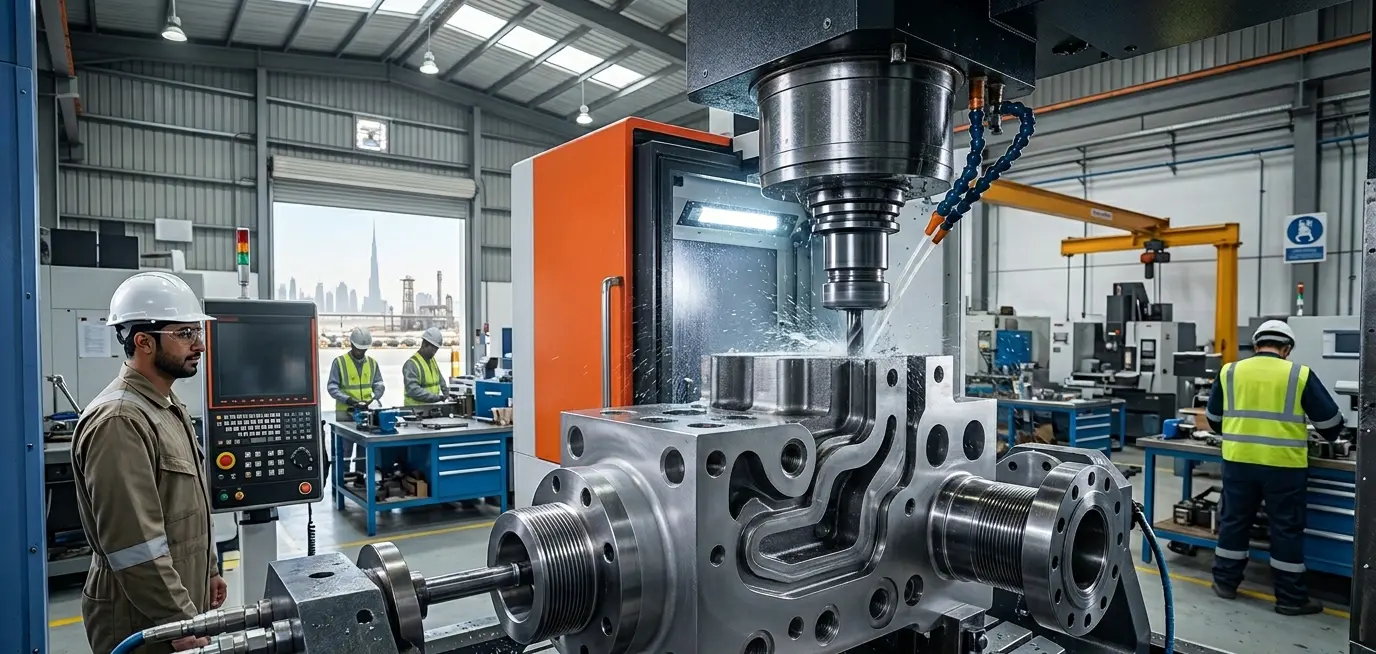

We had a client come to us a few years back. They wanted us to manufacture Safety Valve components. Three different machine shops had quoted the job, two of them cheaper than us. One failed material traceability checks during client inspection while the other one did not have the requisite machining capability. That is the reality of precision CNC machining for oil and gas in this region. The consequences of getting it wrong are not a customer complaint. They are a failed inspection, a deferred project, or in the worst case, a component in service that should never have been there.
This is what separates a general machine shop from a shop that specifically understands oil and gas work. The machining itself is one part of it. Material traceability, API compliance, documentation, and knowing what the component actually does in the field, that is the other part. And most shops only have one of the two.
At a Glance: API-Certified Excellence
- Certifications: API Spec Q1, 5B, 6A, and 7-1 & 7-2 Monogram Licensed.
- Capacity: 90 CNC Machines & 20 Conventional Machines.
- Specialty Alloys: Inconel, Super Duplex, Hastelloy.
- Integrated Services: In-house NDT, Heat Treatment, Copper Plating, Phosphating.
What Makes Oil and Gas CNC Machining Different
Anyone with a CNC lathe can make a round component to a diameter. That is not the hard part.
The hard part in oil and gas is the combination of things that all have to be right simultaneously. Tight tolerances on components made from materials that are actively difficult to machine. Full material traceability from mill certificate to finished part. Compliance with API specifications that most general machine shops have never had to deal with. Non-destructive testing on finished parts before they leave the facility. And all of it documented so a client inspector can sit down and trace every decision made during manufacture.
When one of those things is missing, the component fails inspection. When a component fails inspection on a project with a hard commissioning date, the cost is not the price of the part. It is the standby time, the re-sourcing, and the schedule delay, which can run into hundreds of thousands of dirhams on a major offshore project.
This is why operators and EPC contractors in the UAE who have been around long enough tend to consolidate their precision machined components with shops that have genuine API credentials, in-house testing, and a track record of delivering on tight timelines without cutting corners on documentation.
The Materials Oil and Gas Actually Uses
One thing that separates oil and gas machining from general engineering is the material list. Most of the components that end up in safety-critical applications are not mild steel or standard stainless. They are in alloys that are genuinely hard to machine and that punish the wrong tooling or feeds and speeds very quickly.
Super Duplex and Duplex Stainless Steel
Super Duplex grades like 2507 and F55 are specified constantly across the GCC for subsea components, valve internals, and high-pressure connectors. They combine high strength with excellent corrosion resistance in chloride-heavy environments, which makes them ideal for offshore and seawater service. The machining challenge is that Super Duplex work-hardens rapidly. If your feeds and speeds are not correct, the material hardens ahead of the cutting tool and tool life drops to almost nothing. Getting consistent results from Super Duplex requires the right tooling, the right coolant strategy, and operators who have actually machined it before, not ones learning on your job.
Inconel and Nickel Alloys
Inconel 625, 718, and similar nickel-based alloys are specified for high-temperature applications in gas processing, turbine components, and downhole tools. They hold their strength at elevated temperatures better than almost any other commercially available material. The machining trade-off is that they generate a lot of heat at the cutting zone and they work-harden similarly to duplex stainless. Cutting speeds have to be much lower than on standard stainless. Tooling costs are higher. But when a component needs to survive inside a gas turbine or a downhole environment at sustained high temperatures, there is no substitute.
Alloy Steel, Carbon Steel, and Standard Stainless
Not everything is exotic. A large proportion of oil and gas components machined in Dubai are in 4130, 4140, F22, 316 stainless, and 17-4PH. The challenge here is not the machining itself, it is volume, consistency, and documentation. A valve body in 4140 is not a difficult machine job. Producing 500 of them to the same dimensional spec with full material certs for each one, on time for a project shipment, is where a lot of shops fall apart.
What API Certification Actually Means for Machined Components
API Monogram certification gets mentioned a lot in oil and gas procurement. It is worth being clear about what it actually requires, because not every supplier who claims to work to API standards actually holds the Monogram.
The API Monogram program requires a manufacturer to maintain a documented quality management system that meets API Spec Q1, and to pass a third-party audit demonstrating that the system is actually being followed, not just written down. For specific product types, additional API specifications apply. API 6A covers Blind and Test Flanges. API 5B covers casing and tubing threads. API 7-1 covers Drill Stems and Drill Stem Subs and 7-2 for Rotary Shouldered Connections Threads.
Accurate Edge holds the API Monogram under 5B, 6A, 7-1 & 7-2. That is not a broad claim about quality. It means API’s auditors have specifically verified that our processes for manufacturing components covered by those specifications meet the requirements. When a procurement engineer asks for an API Monogram-stamped component, that stamp means something specific. It means the manufacturer has been audited against the standard, not just that they claim to follow it.
For clients working on projects where the end user is a major operator, API Monogram certification is typically a non-negotiable requirement on the approved vendor list. A shop without it simply cannot supply those projects.
The Machining Capabilities at Accurate Edge
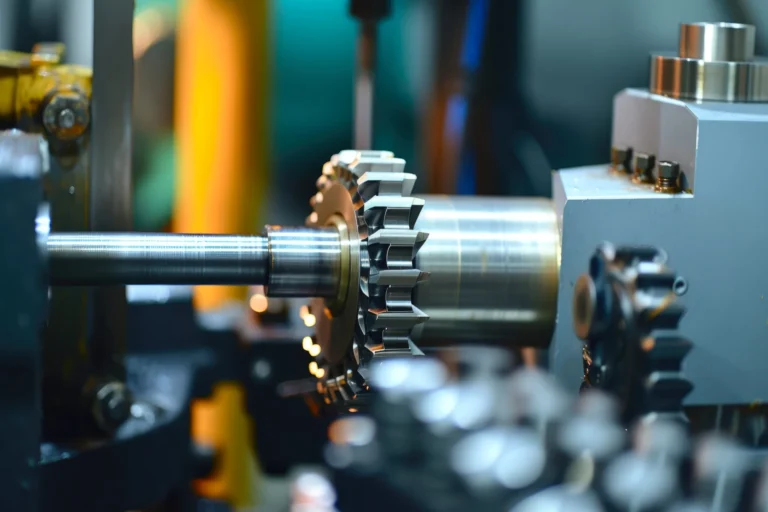
We run CNC lathe machines, equipped with C-axis and hollow spindles. That C-axis capability matters because it lets us mill, drill, and thread on the same setup as turning, without moving the component to a second machine. Every time you move a component between machines, you introduce the risk of datum shift and dimensional error. Doing more operations in a single setup reduces that risk and improves consistency.
For turning, some of our Machines can handle components up to 12 metres in length. That covers most of the large bore and long-barrel components that come up in oil and gas, including drill collar and drill pipe sections, long valve bodies, and tubular goods.
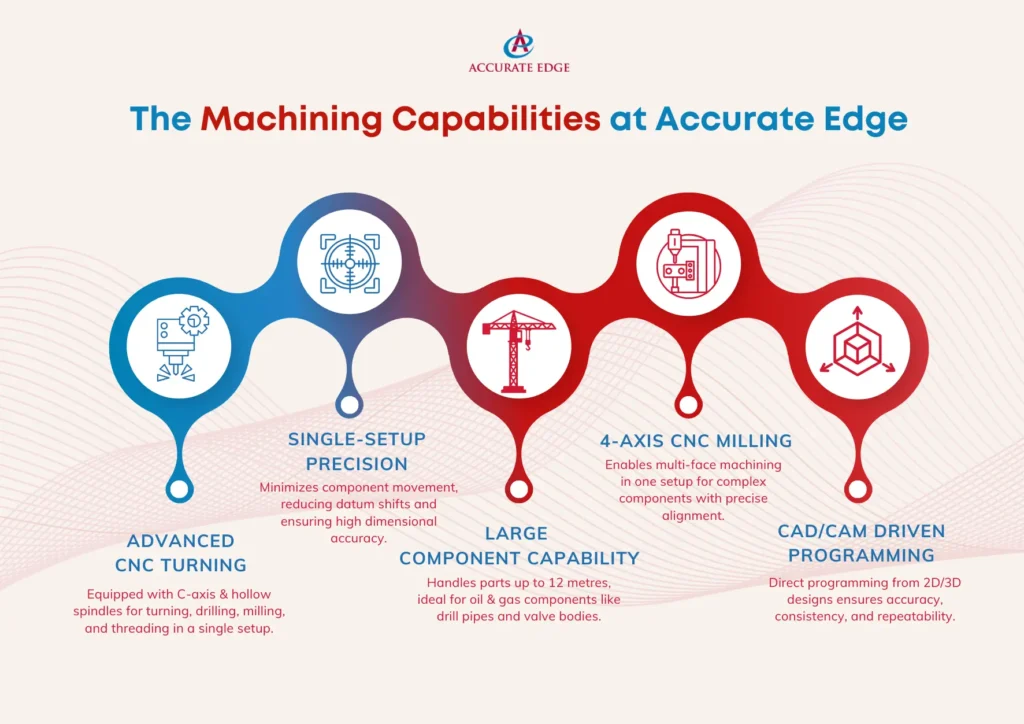
We also run CNC milling machines with a fourth axis. Fourth-axis capability means we can index and machine on multiple faces in a single setup, which is important for complex valve bodies, flanges with multiple bolt hole patterns, and components with features on different faces that all need to be in precise relation to each other.
All programming is done through CAD/CAM software. Components come in as drawings or 3D models and go straight into the CAM system, which means the tool paths are generated from the actual geometry rather than hand-calculated. That consistency in programming is what gives you repeatability from the first part to the hundredth.
Special Processes That Come After Machining
A lot of machine shops stop at machining. The component comes off the CNC and goes out the door. For oil and gas, that is rarely enough.
Most safety-critical components need at least one additional process before they are ready for service. Heat treatment to reach the specified mechanical properties. Non-destructive testing to detect any sub-surface defects that formed during the original material production. Surface coating for corrosion or galling protection. And sometimes all three.
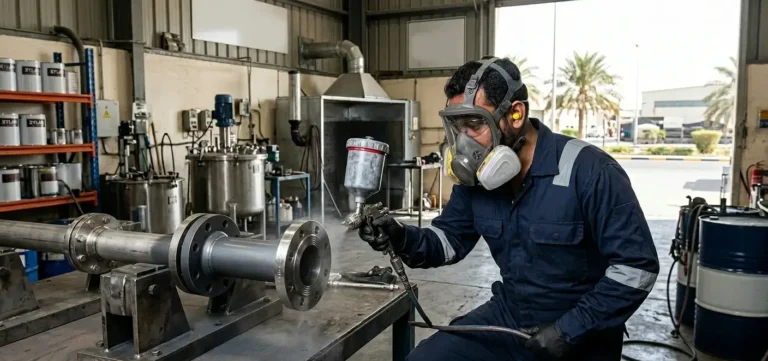
At Accurate Edge, all of these happen in the same facility. Components machined in our CNC shop move directly to our in-house special processes’ facility. Heat treatment is done on site. Our NDT department covers both MPI and LPI inspection. Our coating facility applies Xylan and Xylar, Electroless Nickel Plating, Molybdenum Disulphide, Phosphating, and other surface treatments required by oil and gas specifications.
That single-facility model is not just convenient. It removes the damage and dimensional risk that comes from shipping precision-tolerance components between sites. It removes the lead time of coordinating between separate suppliers. And it gives you one point of contact and one quality system covering the entire manufacturing scope, which is what project managers actually want when they are chasing a commissioning date.
Deep Hole Drilling and Gun Drilling for Oil and Gas
Two processes that come up regularly in oil and gas component manufacturing and that most general machine shops cannot do are deep hole drilling and gun drilling.
Deep hole drilling is needed when a component requires a bore that is too long and too narrow for standard centre drilling. Drill string components, long valve bodies with through bores, and hydraulic manifolds are typical applications. The technical challenge is maintaining straightness over a long bore depth while managing chip evacuation and coolant delivery simultaneously. Without dedicated deep hole drilling equipment and the right process setup, the bore wanders, which renders the component out of specification.
Gun drilling is a specific deep hole drilling process that produces very straight, consistent bores in difficult materials. Common applications include hydraulic passages in valve bodies, cooling channels in tooling, and long bores in downhole tool bodies. Both processes are available in house at Accurate Edge, which means they can be sequenced into the machining workflow without the component leaving the facility.
Quality Control and Documentation
This is the part of the conversation that procurement engineers who have had bad experiences with suppliers care most about.
Every component that goes through our facility has a full documentation trail. Material test reports from the original mill. Dimensional inspection reports at key stages of machining. Heat treatment records with time-temperature charts. NDT inspection reports signed off by certified operators. Coating dry film thickness measurements and batch records. Final dimensional inspection before despatch.
That package of documentation is what enables a client inspector to sit down and verify every step of manufacture against the drawing and specification requirements. It is also what enables traceability if a question arises about a component after it has been in service. Our quality and certification system is ISO 9001:2015 certified and runs through an independent QC department with calibrated, traceable gauges.
Components We Machine for Oil and Gas
The range of components that come through our facility for oil and gas clients is broad. The most common ones are:
Safety Valve components and bonnets in stainless, duplex, super duplex, and Inconel. Gate valve stems and seats. Pump casings, impellers, and shaft sleeves. Wellhead and Christmas tree components, Drill collar and crossover subs, Casing accessories and pup joints, Flanges and connectors to ASME B16.5 and API standards. Downhole tool bodies in exotic alloys. Subsea connector bodies and end fittings. Manifold blocks with complex internal bore geometries.
If it is a machined metal component that ends up in an oil and gas application and the drawing has tolerances and material requirements that actually matter, it is the kind of work we do.
Frequently Asked Questions
What is precision CNC machining for oil and gas?
Precision CNC machining for oil and gas is the manufacture of metal components using computer-controlled machining equipment to tight dimensional tolerances from specified materials, with full material traceability and compliance with relevant industry standards such as API, ASME, and ISO. In oil and gas, precision machining covers components like Safety Valve components, pump parts, wellhead equipment, downhole tools, and structural connectors.
Why does API certification matter for CNC machined components in the UAE?
API certification means the manufacturer has been audited by the API against specific product standards and quality management requirements. For components used in safety-critical oil and gas applications, most major operators in the UAE and GCC require suppliers to hold the API Monogram for the relevant product category. A shop without it cannot supply those projects regardless of the quality of their machining.
What materials does Accurate Edge machine for oil and gas clients?
We machine Super Duplex, Duplex Stainless, Inconel, Hastelloy, 17-4PH, 316 and 316L Stainless, 4130, 4140, F22, and other alloy and carbon steels. Most of the materials on oil and gas drawings that require special handling are materials we machine regularly. See our full services page for more detail.
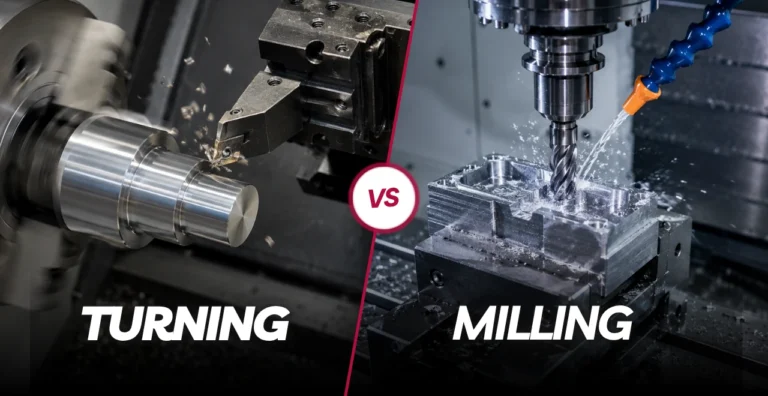
What is the difference between CNC turning and CNC milling?
CNC turning rotates the component against a stationary cutting tool to produce cylindrical features like bores, outer diameters, and threads. CNC milling moves a rotating cutting tool against a stationary component to produce flat faces, slots, pockets, and profiled features. Most complex oil and gas components require both operations. Our C-axis lathes allow us to perform milling operations on the same machine as turning, reducing setups and improving dimensional consistency. Turning is used for drill collars and pins, while milling is used for complex manifold blocks and valve seats.
Can you handle deep hole drilling and gun drilling in house?
Yes. Both deep hole drilling and gun drilling are available in house at our Dubai Investment Park facility. These are processes that most general machine shops in the UAE do not have the equipment for, which is why they come up regularly when clients are looking for a single supplier to cover the full manufacturing scope of a complex component.
Do you provide NDT inspection and heat treatment in house?
Yes. Both non-destructive testing and heat treatment are done in house at the same facility as the machining. MPI and LPI for NDT. Full traceability on heat treatment records. Components do not leave the facility between processes.
What coatings can be applied after machining?
We apply Whitford Xylan and Xylar coatings, Electroless Nickel Plating, Molybdenum Disulfide, Phosphating, Everlube and Everslik, Hard Gold Plating, Copper Plating, and Induction Hardening. All applied in house after machining.
How long has Accurate Edge been doing oil and gas CNC machining in the UAE?
Since 2007. We started with 3 machines and 11 people in Sharjah. We now operate 140 plus machines across 3 facilities with over 400 people. We have never lost a client in that time, which in this industry says more than any certification.
Where is Accurate Edge located?
Our main facility is in Dubai Investment Park 1, Dubai, UAE. We serve clients across the UAE, GCC, and MENA region. Most of our oil and gas clients are in Abu Dhabi, Dubai, and Sharjah, with project work extending across the Gulf.
Visit Our DIP Facility
We maintain an open-door policy for quality audits. Technical teams and procurement managers are invited to our Dubai Investment Park 1 facility to inspect our CNC capacity, witness our NDT processes, and review our API-compliant documentation system first hand. We believe that seeing the scale of our 140+ machines and our rigorous quality controls in person is the best way to start a long-term partnership.
Why Accurate Edge for CNC Machining in Oil and Gas
There are plenty of machine shops in the UAE. Most of them can turn a shaft or bore a hole. The ones that can do that on Super Duplex, to API tolerances, with full material traceability, NDT in house, and coating in the same facility, on a project timeline, are much fewer.
We are API Monogram licensed under 5B, 6A, 7-1, 7-2 & also ISO 9001:2015 certified. Approved for Xylan and Xylar coating. We have CNC lathes, milling machines, our own deep hole drilling and gun drilling equipment, in-house NDT, in-house heat treatment, and a full coating facility. All of it on one site, under one quality system, with one set of documentation.
If you are sourcing machined components for an oil and gas project in the UAE and you need API certification, full traceability, and in-house special processes, we are the conversation worth having.