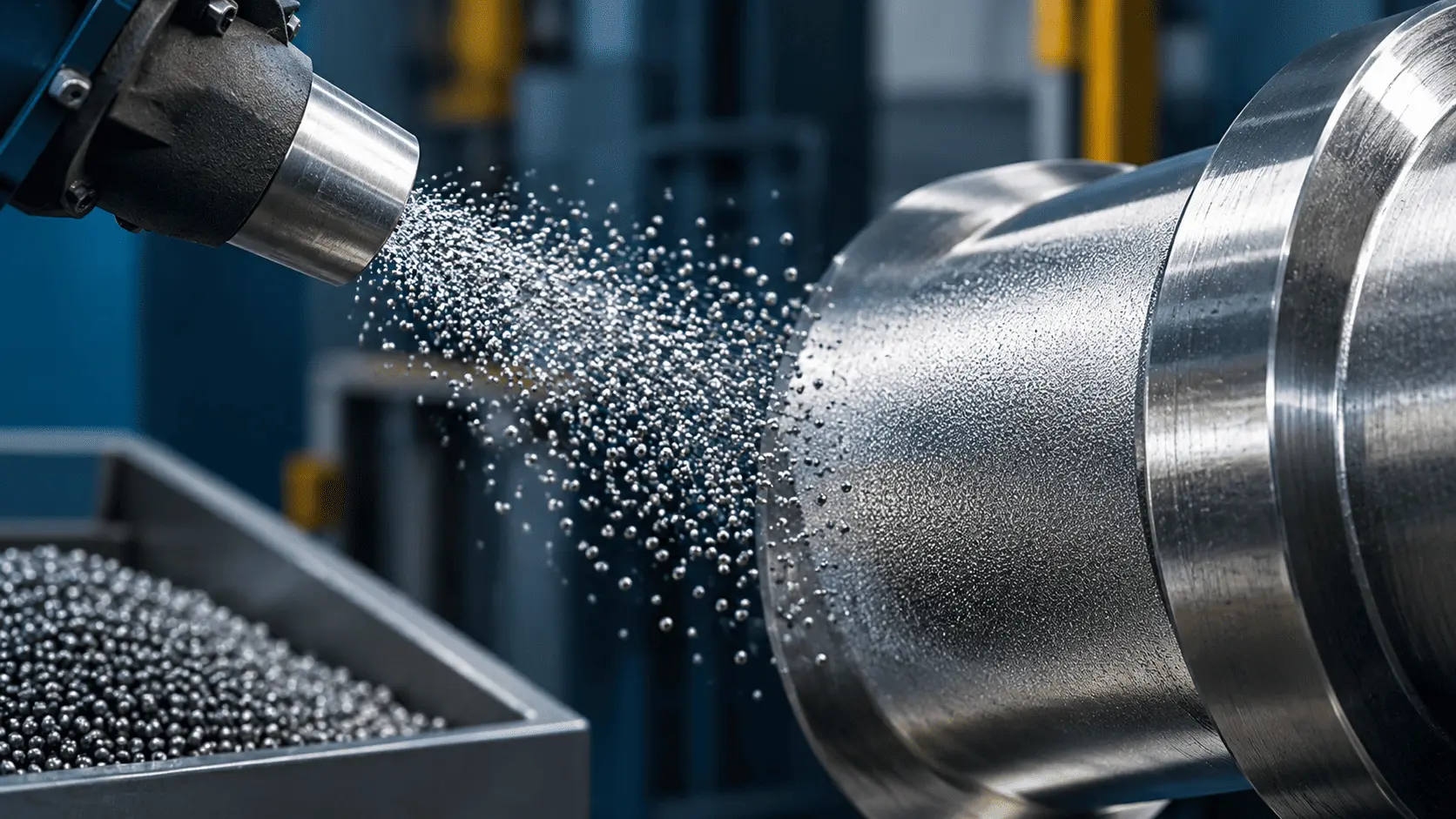

Shot peening is a cold working process used to produce a compressive residual stress layer and modify the mechanical properties of metals. Manufacturers rely on it to extend the service life of critical components by preventing fatigue cracking and stress corrosion before they ever start.
Unlike coating or heat treatment, shot peening changes a part’s performance from the inside out, strengthening the surface layer through controlled mechanical impact rather than chemical or thermal means. For industries across the UAE and the wider Gulf region, where components in oil and gas, aviation, and heavy manufacturing face relentless stress and harsh operating conditions, this process has become a standard step in extending equipment life and reducing unplanned failures. Accurate Edge provides certified shot peening services across the UAE.
The Core Mechanics: What is the Purpose of Shot Peening?
The purpose of shot peening is to improve the fatigue strength and durability of metal components by inducing beneficial compressive residual stress at the surface.
Here’s how it works, explained simply. Small, round particles of media, known as the shot, are propelled at high velocity against the surface of a metal part. Each impact creates a tiny dimple, similar to a miniature hammer blow. As the metal beneath that dimple tries to spring back and restore its original shape, it is held in check by the surrounding material. This resistance creates a hemisphere of cold-worked metal that sits in a permanent state of compression.
This compressive layer is the entire point of the process. Most fatigue failures and stress corrosion cracking start at the surface, where tensile stress pulls microscopic flaws apart until a crack forms and propagates through the material. A compressive layer counteracts that tensile stress, meaning cracks have to work much harder to initiate and grow. In effect, the part is given a built-in defense mechanism against the exact forces that would otherwise shorten its working life.
The key benefits of shot peening include:
- Preventing micro-cracking by closing off the surface flaws where cracks typically begin
- Improving fatigue strength, often extending a part’s usable life by several times over an unpeened equivalent
- Increasing resistance to galling and fretting, which is especially valuable for parts that experience repeated friction or rubbing contact
- Enhancing resistance to stress corrosion cracking, particularly in harsh, high-humidity, or high-temperature environments such as those found across the Gulf’s industrial and coastal sites
Because the effect is achieved mechanically rather than through a coating, it does not wear off or degrade the way a surface treatment might. It is built directly into the metal’s microstructure, making it a permanent, verifiable improvement rather than a temporary fix.
How is Shot Peening Done? The Step-by-Step Process
How is shot peening done in practice? The process follows a controlled, repeatable sequence designed to guarantee consistent, verifiable results across every part, batch after batch.
- Preparation: Cleaning the surface. Before peening begins, the component is cleaned to remove oil, dirt, scale, or any contaminants that could interfere with media impact or contaminate the equipment. A clean surface ensures the shot makes direct, unobstructed contact with the base metal.
- Selecting the media. Operators choose the shot type based on the part’s material and required intensity. Common options include cast steel shot (durable and cost-effective for heavy-duty parts), ceramic beads (a good middle ground for precision and durability), and glass beads (gentle enough for softer alloys like aluminum). The size and hardness of the media directly affect how deep and intense the compressive layer will be, so this step is far from arbitrary; it is engineered to the specific part and its expected service conditions.
- The impact phase. The selected media is accelerated toward the part’s surface using specialized equipment, either air blast systems or centrifugal blast wheels (covered in detail below). Velocity, angle, exposure time, and nozzle or wheel distance are all tightly controlled to hit a specific target intensity, rather than simply blasting the part until it “looks done.”
- Coverage measurement. This is where shot peening earns its reputation as a precision process rather than a rough abrasive treatment. Operators use Almen strips, thin, standardized metal strips that are peened alongside the actual part, to measure the process intensity, known as Almen intensity. The strip’s resulting curvature is measured with an Almen gauge and compared against a target specification. Coverage is then visually verified, typically with the aid of a fluorescent tracer, to confirm that 100 percent of the required surface area has been struck by the media before the job is signed off.
This step-by-step discipline is what separates shot peening from a generic blasting operation. Every part is engineered to a measurable, repeatable result, which is why aerospace and defense specifications treat it as a controlled manufacturing process rather than a cosmetic finishing step.
Inside the Equipment: What is a Shot Peening Machine?
A shot peening machine is the equipment responsible for propelling media at a controlled velocity and angle onto a part’s surface. There are two primary types of delivery systems, and the right choice depends on the part’s size, geometry, and required precision.
Air Blast Systems: These machines use compressed air to project shot through a nozzle at high speed. Because the airflow and nozzle position can be finely adjusted, air blast systems offer excellent precision and are well suited for smaller parts, complex geometries, and applications where localized or selective peening is required, such as fillets, weld toes, or specific stress-concentration zones. Their flexibility makes them a common choice for job shops handling a wide variety of part types and sizes.
Centrifugal Blast Wheels: These systems use one or more spinning wheels fitted with blades to fling media at the part through centrifugal force. They deliver a much higher volume of shot per minute than air blast systems, making them ideal for large components or high-throughput production lines where uniform coverage over a large surface area matters more than pinpoint targeting. Automotive springs and structural components are frequently processed this way.
Modern shot peening machines increasingly incorporate automation and robotics, including programmable arms, rotating fixtures, and sensor-based feedback loops, to maintain consistent nozzle distance, angle, and dwell time across every part. This automation is critical in industries like aerospace, where even minor inconsistencies in Almen intensity or coverage can compromise a component’s certified fatigue life. Automated systems also reduce operator-to-operator variability, which matters greatly when a facility is producing parts to a fixed, auditable specification.
Shot Peening vs Shot Blasting: What’s the Difference?
Shot peening vs shot blasting is one of the most common points of confusion in the metalworking world, and it is easy to see why. Both processes use similar-looking equipment and propel media at a metal surface at high speed. But their goals, and their outcomes, are entirely different.
Shot blasting is primarily a cleaning and surface-preparation process. It is used to strip away rust, old paint, mill scale, or other surface contaminants, and to prepare a surface for coating or painting by creating a rough profile that helps with adhesion.
Shot peening, by contrast, is a strengthening process. Its goal is not to clean the surface but to engineer a compressive residual stress layer that improves fatigue life and resistance to cracking. The intensity, media type, and coverage are all tightly controlled and measured, whereas shot blasting is generally less concerned with precise, verifiable outcomes and more focused on visual cleanliness.
| Feature | Shot Peening | Shot Blasting |
| Primary Goal | Strengthen the metal by inducing compressive residual stress | Clean the surface (remove rust, paint, or scale) |
| Media Used | Precisely selected cast steel, ceramic, or glass beads | Steel grit, sand, or other abrasive media, less tightly specified |
| Precision Level | High, controlled and verified with Almen strips and gauges | Low to moderate, generally assessed with visual or general surface-quality inspection |
| Industry Focus | Aerospace, automotive, and other fatigue-critical components | Foundries, structural steel, and general surface preparation |
Understanding this distinction matters because using the wrong process, or assuming shot blasting delivers peening’s fatigue benefits, can leave a critical component without the protection it actually needs. A part that looks clean and uniform after blasting has not necessarily gained any resistance to fatigue failure.
Top Shot Peening Applications Across Industries
Shot peening applications span nearly every industry where metal components face repeated stress, vibration, or cyclic loading.
- Aerospace: Landing gear, turbine blades, and aircraft wings all rely on shot peening to withstand the extreme, repeated stress cycles of flight. In this industry, peening is not optional; it is a certified, specification-driven part of manufacturing critical safety components, often governed by strict aerospace material standards.
- Automotive: Gears, springs, connecting rods, and transmission parts are commonly peened to survive the constant cyclic loading of engine and drivetrain operation, extending component life well beyond what untreated parts could achieve. Suspension springs, in particular, depend on peening to resist the millions of load cycles they experience over a vehicle’s lifetime.
- Manufacturing & Oil/Gas: Heavy machinery components subjected to high cyclic stress, such as drill shafts, valve springs, and structural fasteners, benefit from the same fatigue-resistance principles, helping reduce unplanned downtime and costly failures in demanding operating environments. This is especially relevant in the UAE’s oil, gas, and heavy industrial sectors, where equipment often runs continuously in high-heat, high-load conditions.
Beyond these core sectors, shot peening is also used in medical device manufacturing, power generation, and rail, wherever a metal part needs to reliably outlast years of repeated stress. As industrial demand across the UAE and broader GCC region continues to grow, more manufacturers are turning to certified peening services to meet both performance requirements and international quality standards.
Key Advantages of Shot Peening
Before weighing any trade-offs, it’s worth looking at why shot peening has become a standard, trusted process across so many industries in the first place. The advantages go well beyond simple surface hardening.
- Significantly longer fatigue life. By locking in a compressive residual stress layer, peened parts can withstand many more load cycles before a fatigue crack has any chance of forming, in some cases multiplying service life several times over.
- Stronger resistance to stress corrosion cracking. Components exposed to moisture, chemicals, or salt-laden air, common across coastal and industrial sites in the UAE, hold up far better once they carry a compressive surface layer.
- Improved resistance to galling and fretting. Parts that rub or move against one another under load experience less surface wear and a longer working life after peening.
- A permanent, engineered improvement. Because the benefit is built into the metal’s microstructure rather than applied as a coating, it doesn’t peel, flake, or wear away over time the way a surface finish might.
- Cost-effective compared to alternatives. Relative to a dedicated stress-relief process like post-weld heat treatment or replacing failed parts altogether, shot peening is a fast, economical way to add years of service life to a component.
- Verifiable, repeatable quality. With Almen strip testing and coverage checks built into every job, customers get a documented, specification-backed result rather than a best guess.
Taken together, these advantages are exactly why aerospace, automotive, and heavy industrial manufacturers treat shot peening as a core part of their quality and reliability strategy rather than an optional extra.
What Are the Disadvantages of Shot Peening?
Like any manufacturing process, shot peening has a few trade-offs worth knowing about. None of them outweigh the benefits above when the process is handled by an experienced provider, but they’re worth understanding so expectations are set correctly from the start.
- Increased surface roughness. The impact process can leave a textured, dimpled surface finish, which may require secondary polishing or finishing for applications with strict surface-quality requirements. This is easily planned for at the design stage.
- Potential distortion of thin or delicate parts. Parts with thin cross-sections can warp or distort if peening intensity isn’t carefully controlled, which is why proper process setup and an experienced operator matter so much for lightweight or precision components.
- Specialized equipment and quality control. Achieving verifiable, specification-grade results requires calibrated equipment, Almen strips, and rigorous quality checks, which add a modest amount of cost and process time compared to simpler surface treatments, but deliver a far more reliable, longer-lasting part in return.
In practice, these considerations are simply part of good process planning. With the right media, intensity, and equipment matched to each part, an experienced shot peening provider can avoid these drawbacks almost entirely while still delivering the full fatigue-life benefit.
Advantages vs Disadvantages at a Glance
| Advantages of Shot Peening | Disadvantages of Shot Peening |
| Extends fatigue life, often by several times | Can increase surface roughness |
| Boosts resistance to stress corrosion cracking | May require secondary polishing for tight tolerances |
| Improves resistance to galling and fretting | Risk of distortion on thin or delicate parts if uncontrolled |
| Permanent, built into the metal’s microstructure | Requires specialized equipment and quality control |
| Verifiable results via Almen testing | Adds modest cost and process time versus simpler treatments |
| Cost-effective versus heat treatment or part replacement | Needs an experienced operator to get the setup right |
Frequently Asked Questions (FAQs)
Does shot peening harden the surface?
Yes. The repeated mechanical impact causes work hardening at the surface, increasing hardness in addition to inducing the compressive residual stress layer that improves fatigue resistance.
Can you shot peen aluminum?
Yes, aluminum components can be shot peened, but they typically require gentler media, such as glass beads, to avoid embedding contaminants or over-stressing the softer alloy.
What is Almen intensity?
Almen intensity is a standardized measurement of a shot peening process’s strength, determined by the curvature of a peened Almen strip. It is used to ensure consistent, repeatable results across production runs and different operators.
Does shot peening improve corrosion resistance?
Indirectly, yes. By reducing surface tensile stress, shot peening lowers the likelihood of stress corrosion cracking, making it a valuable process for parts exposed to corrosive or humid environments.
Final Thoughts
Shot peening remains one of the most reliable, well-documented ways to extend the working life of metal components under repeated stress. From aerospace-grade landing gear to automotive springs and heavy industrial machinery, the process delivers measurable, engineered improvements in fatigue life that few alternative treatments can match. For manufacturers and maintenance teams across the UAE looking to reduce part failures and meet demanding international specifications, understanding when and how to apply shot peening, and how it differs from simple shot blasting, is an essential first step toward building longer-lasting, more reliable equipment.