
Every strong weld has a quiet story behind it, and more often than not, that story starts and ends with a little carefully controlled heat. The best part? Once you understand how it works, getting it right is far more achievable than most people expect.
Preheating and post-weld heat treatment aren’t rivals competing for a place in your procedure. Think of them as two good teammates, one looking after the weld while it’s being made, the other looking after it for the long run. Across the UAE’s oil and gas, petrochemical, and heavy fabrication sectors, where welds are expected to perform for decades under pressure and heat, this teamwork is what keeps equipment safe and reliable.
In this guide, we’ll walk through Preheating vs PWHT in plain language: what each one does, where they differ, how the quality side is monitored, and how to pick the right partner for your project.
What Is Preheating in Welding?
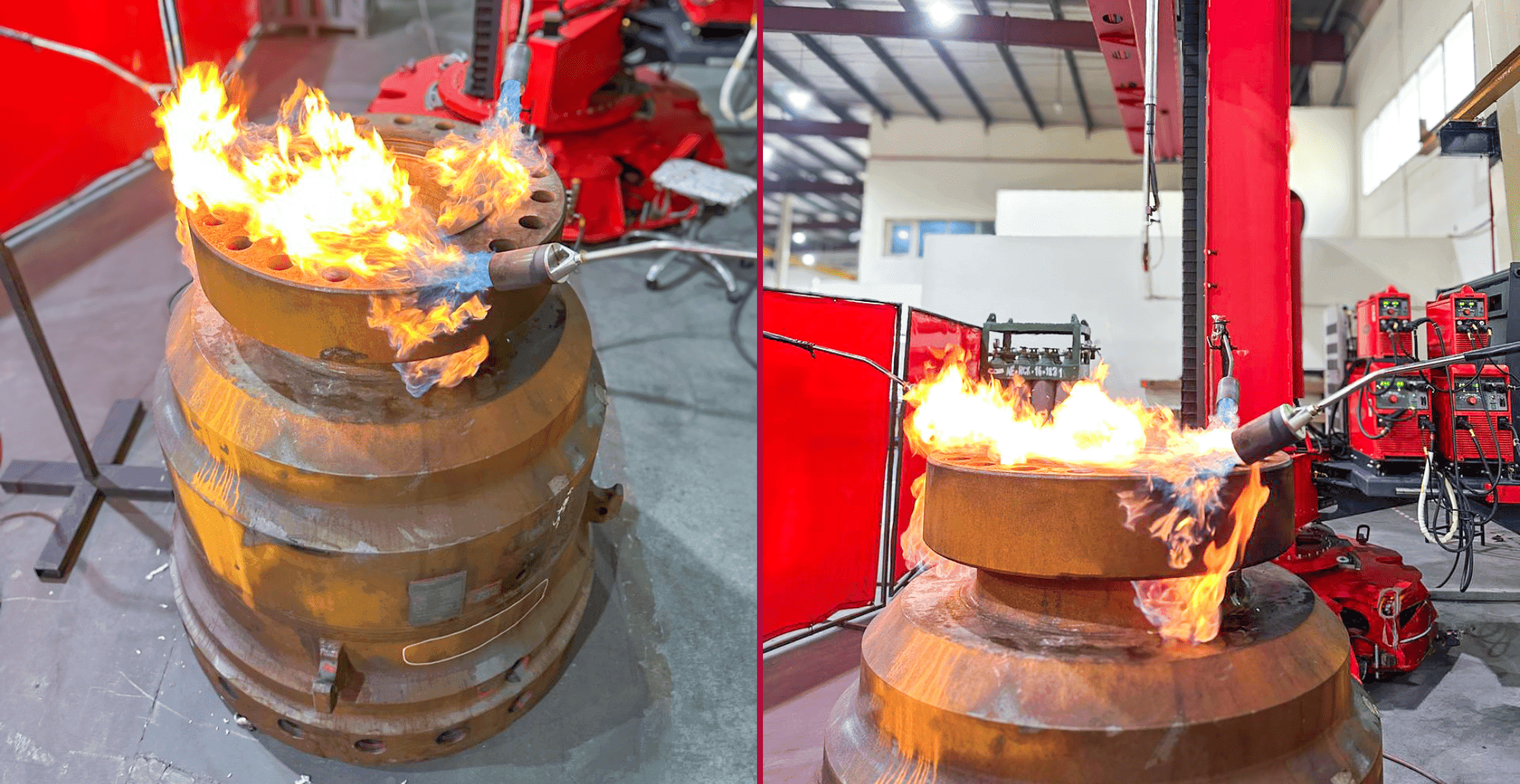
Preheating simply means warming the base metal to a specified minimum temperature before welding starts, then keeping it at or above that level while the weld is made. It sounds modest, but it changes how the weld and the metal around it behave as they cool.
Why Is Preheating Important?
When a weld cools too quickly, the metal right next to it, known as the heat-affected zone (HAZ), can turn hard and brittle. Preheating gives the metal a gentler cooling curve, and that brings some very welcome benefits:
- It lowers the risk of hydrogen-induced cold cracking, one of the most common problems in steel welding.
- It keeps HAZ hardness within acceptable limits.
- It drives off surface moisture, which is a hidden source of hydrogen.
- It reduces temperature differences across the joint, so shrinkage stresses build up more gently.
When Is Preheating Required?
There’s no single trigger. Preheating is usually called for when several conditions come together, such as:
- Steels with higher carbon equivalent or alloy content, including many Cr-Mo grades
- Thick sections that pull heat away from the weld quickly
- Highly restrained joints, where the surrounding structure resists movement
- Cold or damp working conditions
- Consumables or processes with a higher hydrogen potential
The actual minimum temperature always comes from the applicable code and your approved welding procedure, so it’s never a guessing game.
Common Preheating Methods
The right method depends on the size of the component and where the work is happening:
- Gas torches and burners: Flexible and popular for smaller jobs and field work, though they take a skilled hand to heat evenly.
- Electric resistance heating: Heating elements wrapped around the joint give steady, uniform heat, which is why they’re a favourite for pipework and vessels.
- Induction heating: Quick and efficient, with excellent control on pipes and larger sections.
- Furnace heating: A good fit for smaller parts that can be heated as a whole.
Whichever method is used, the temperature is verified with contact thermometers, temperature-indicating crayons, or thermocouples, so the welder knows the minimum has genuinely been reached before striking the arc.
What Is Post-Weld Heat Treatment (PWHT)?
Post-weld heat treatment, or PWHT, is a controlled heating and cooling cycle carried out once welding is finished. The component is brought up to a temperature below its lower critical point, held there for a set time, and then cooled at a controlled rate.
If preheating is the careful preparation, PWHT is the finishing care that makes the weld ready for years of service.
Why Is PWHT Performed After Welding?
Welding leaves behind residual stresses, and in many steels it also leaves a hardened microstructure in the HAZ. PWHT tackles both. It’s carried out to:
- Relieve the residual stresses locked in by welding
- Temper hard, brittle microstructures so toughness and ductility improve
- Improve dimensional stability, especially for parts that will be machined afterwards
- Reduce the risk of stress corrosion cracking in aggressive service
- Help meet the hardness limits required for sour service environments
How Does the PWHT Process Work?
A typical cycle has three stages, and each one matters.
First comes controlled heating. The component is heated at a managed rate so the temperature stays even through the thickness. Next is soaking, where the component is held at the target temperature. A common rule of thumb is about one hour per 25 mm of thickness, though the governing code sets the actual minimums. Finally, the component is cooled at a controlled rate, often inside the furnace or under insulation, until it reaches a temperature where it can safely cool in still air.
Target temperatures depend on the material. Carbon steels are commonly treated at roughly 600 to 650°C, while Cr-Mo alloy steels are often treated at higher temperatures. As always, the exact figures come from the code and the approved procedure.
Common PWHT Methods
- Furnace PWHT: The whole fabrication, or a section of it, goes into a controlled furnace. It gives the most uniform results wherever size allows.
- Local PWHT with electric resistance heating: Heating elements and insulation are applied around a joint, which makes it practical for pipework, nozzles, and large vessels that can’t fit in a furnace.
- Induction heating: Fast, precise local heating, particularly handy on pipes.
- Gas-fired heating: Used on certain large vessels, including internal firing set-ups, where other methods aren’t practical.
Preheating vs PWHT: Key Differences
The easiest way to see the difference between preheat and PWHT in welding is to think about timing and purpose. Preheating protects the weld while it’s being made. PWHT improves the weld once it’s complete.
| Factor | Preheating | PWHT |
| Timing | Before and during welding | After welding is completed |
| Typical Temperature | Lower, often 100 to 250°C | Much higher, often 590 to 760°C |
| Main Purpose | Prevent cracking, slow cooling | Relieve stress, temper the microstructure |
| Controls | Hydrogen cracking and HAZ hardness | Residual stress, toughness, stability |
| Equipment | Torches, resistance, induction | Furnaces, resistance, induction |
| Effort and Time | Shorter, built into welding | Longer, a separate controlled cycle |
| Requirement Driver | Material, thickness, restraint | Code, thickness, service conditions |
Seen this way, PWHT vs preheating welding isn’t really an either-or choice. Most critical applications use both, because each one covers something the other can’t.
Postheating is sometimes called hydrogen bake-out. It helps hydrogen escape, but it doesn’t change the microstructure the way PWHT does. Different tools, different jobs.
What Factors Determine Preheating and PWHT Requirements?
There’s no one-size-fits-all answer, but the factors are well known:
- Material composition: Carbon equivalent and alloy content strongly influence hardenability and cracking risk.
- Thickness: Thicker sections cool faster and carry higher stresses.
- Joint restraint: Highly restrained joints need extra care with heat control.
- Hydrogen level: Low-hydrogen consumables can reduce the preheat needed.
- Ambient conditions: Cold or damp conditions raise the cracking risk.
- Governing code or standard: ASME, API, AWS, and EN standards each set their own rules and exemptions.
- Service conditions: Sour service, high temperature, and cyclic loading can all bring in PWHT requirements.
All of this comes together in the welding procedure specification, which is the document everyone on the project should follow.
Preheating and PWHT in Oil and Gas Applications
Oil and gas facilities depend on thick-walled, high-pressure equipment, so preheat and PWHT are part of everyday fabrication. You’ll find them on:
- Pressure vessels and reactors, often built from Cr-Mo steels
- Process and transmission piping fabricated to codes such as ASME B31.3
- Heat exchangers and boiler components
- Sour service equipment, where hardness limits under standards such as NACE MR0175 / ISO 15156 must be met to resist sulphide stress cracking
In the Gulf’s demanding operating conditions, consistent heat treatment is a big part of delivering equipment that stays safe and dependable throughout its service life.
- Time-temperature charts for each thermocouple
- Thermocouple location sketches
- Calibration certificates for controllers and recorders
- Hardness test results, where required
- Component and weld identification for full traceability
How to Choose a Suitable PWHT Service Provider
The right partner makes the whole process smoother and gives you real confidence in the result. When comparing providers, it helps to look for:
- Code knowledge: Familiarity with ASME, API, and whichever standards your project follows
- Material experience: Proven work on your steel grades, including Cr-Mo and other alloys
- Suitable equipment: Furnaces and local heating systems that fit your component size and shape
- Calibrated, reliable control: PLC-controlled equipment with calibrated recorders
- Complete documentation: Clear charts, records, and traceability delivered with the work
- Integrated support: The ability to combine heat treatment with welding, inspection, and testing
- Responsiveness: Realistic lead times and clear communication from enquiry to delivery
PWHT Services and Welding Services from Accurate Edge
At Accurate Edge, we’re proud to support clients across the UAE with dependable PWHT services and welding services, planned around each project’s code requirements and material demands. Our team works with you from the start to get preheat, interpass control, and heat treatment right, so your components arrive with the quality records your project needs.
Planning a project that needs reliable heat treatment or welding? Contact Accurate Edge to request a quotation or speak with our team about your PWHT and welding requirements. We’re ready to help.
Conclusion
At its heart, Preheating vs PWHT is really about seeing how the two work together. Preheating protects the weld while it’s being made, and PWHT improves the finished weld by relieving stress and tempering the structure. When both are specified correctly, controlled carefully, and documented properly, you get a weld that performs reliably for years. Whether you’re fabricating pressure equipment, piping, or heavy structures, planning preheat and PWHT early is one of the smartest ways to keep your project on schedule and your welds in top condition.
Frequently Asked Questions (FAQs)
What is the main difference between preheating and PWHT?
Preheating is done before and during welding to slow cooling and prevent cracking, while PWHT is done after welding at a much higher temperature to relieve residual stress and temper the microstructure.
Is PWHT always required after welding?
No. PWHT is needed when the code, material, thickness, or service conditions call for it, such as many Cr-Mo steels, thick pressure-containing parts, and sour service equipment. Your welding procedure and the governing code will say whether it applies.
What is the difference between preheating and post weld heat treatment?
They happen at different stages and do different jobs. When people compare Preheating vs Post Weld Heat Treatment, it comes down to prevention versus correction: preheating lowers the risk of cracking during welding, while PWHT improves toughness and relieves the stresses that remain after the weld has cooled.
What temperature is used for PWHT?
It depends on the material and the code. Carbon steels are commonly treated at roughly 600 to 650°C, while alloy steels often need higher temperatures. The exact temperature and soaking time are set in the approved procedure.
Can PWHT be done on site?
Yes. Local PWHT using electric resistance or induction heating allows welded joints on piping and large vessels to be treated on site, as long as the heating, insulation, and temperature monitoring meet the procedure requirements.
Why are thermocouples used in PWHT?
Thermocouples measure the real temperature of the component. That lets the team confirm the heating rate, soaking temperature, and cooling rate stay within the specified limits, and it provides the data for the quality records.