
Every moving part tells a small story about friction. Left unmanaged, that story ends in heat, wear and unplanned downtime. A thin, well-chosen coating can change the ending, keeping parts sliding smoothly, resisting sticking and lasting far longer between replacements.
This guide explains the MoS₂ vs PTFE coating question in plain terms: what each coating is, how they compare, where each one works best and how to choose. It is written for engineers, maintenance teams and buyers across the UAE who want a clear answer before committing to a specification.
Quick Answer: Neither is universally better. MoS2 suits high load, high temperature and dry or vacuum sliding. PTFE suits non-stick, chemical resistance and cleaner, lower-load duty. Choose by load, temperature, environment and food or chemical contact.
MoS2 vs PTFE Coating: What Is the Difference?
Both coatings reduce friction, but they do it in different ways and shine in different conditions. Knowing the difference is the first step to choosing well.
What Is MoS₂ Coating?
MoS₂ coating uses Molybdenum Disulphide, a solid lubricant with a layered crystal structure. The layers slide easily over one another, which gives very low friction even under heavy pressure. It is usually applied as a thin dry film, either bonded with a resin binder or deposited by a process such as sputtering, and it works without oil or grease. That makes it valuable where liquid lubricants would burn off, squeeze out or attract dust.
What Is PTFE Coating?
PTFE coating is based on polytetrafluoroethylene, a fluoropolymer known for its slick, non-stick surface, strong chemical resistance and good electrical insulation. It is applied as a liquid or powder system and cured with heat to form a thin, smooth film. It releases sticky materials easily and resists many chemicals, although it is softer than a bonded dry film lubricant.
MoS₂ vs PTFE Coating: Side-by-Side Comparison
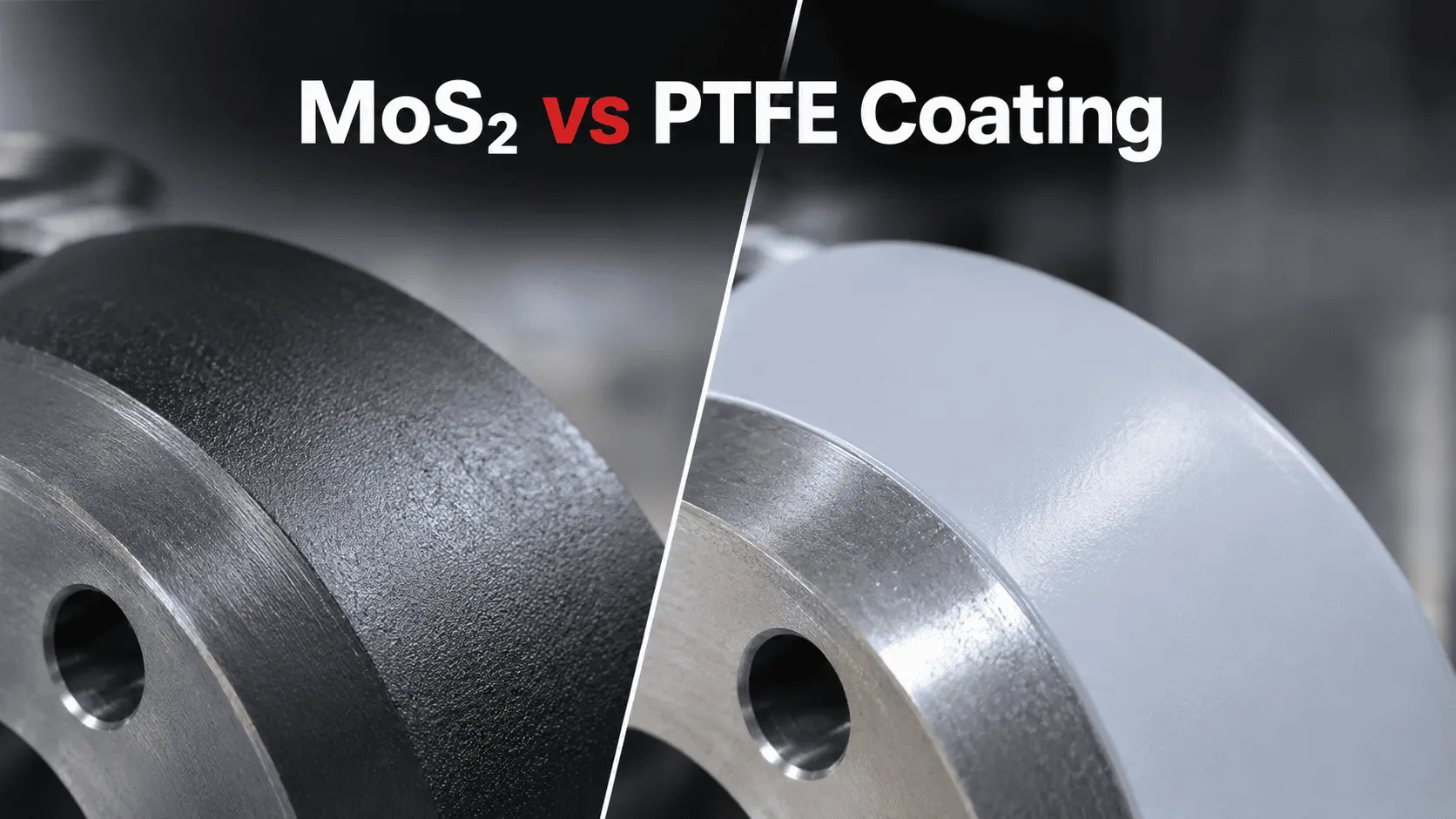
MoS₂ is generally the stronger choice under heavy load and heat, while PTFE is generally the stronger choice for non-stick, chemical and clean applications.
| Property | MoS₂ | PTFE |
| Type | Solid dry film lubricant | Fluoropolymer |
| Load capacity | High, suited to heavy contact pressure | Moderate, softer film |
| Friction | Very low, especially in dry or vacuum conditions | Very low, with a non-stick surface |
| Temperature | Performs well at high temperatures, depending on the binder | Good, commonly quoted up to around 260 °C |
| Chemical resistance | Moderate | Excellent |
| Non-stick and release | Not its main strength | Excellent |
| Humidity | Friction can rise in humid conditions | Largely unaffected |
| Food and pharma contact | Generally not suitable | Suitable grades available |
| Typical uses | Threads, gears, bearings, dies, fasteners | Moulds, rollers, hoppers, valves, seals |
Treat the table as a general guide. Real performance depends on the binder, thickness, substrate, surface preparation and cure, so always check the coating system’s data sheet. Some hybrid systems blend PTFE and MoS₂ to balance properties.
Local conditions also shift the balance. Desert dust sticks to oil and grease and turns them into an abrasive paste, so a dry film is attractive for exposed sliding parts. Coastal humidity, on the other hand, can reduce the benefit of MoS₂ on parts that stay damp, which is where PTFE often has the edge. High summer temperatures matter too, because they affect both the coating limit and the way mating parts expand.
How the Coating Process Works
A good coating job depends as much on preparation as on the coating itself. The typical sequence looks like this:
- Inspection and cleaning: parts are degreased and cleared of rust, oil and contamination.
- Surface preparation: grit blasting, phosphating or another treatment creates a clean, keyed surface, depending on the system.
- Application: the coating is sprayed, dipped or tumbled on, with masking for areas that must stay uncoated. MoS₂ can also be burnished or sputtered for precision work.
- Curing: the film is air dried or oven cured according to the data sheet. Cure schedules must be followed exactly.
- Inspection: coating thickness, adhesion (for example by a cross-hatch test) and appearance are checked.
Coatings are thin, but not zero. Allow for coating thickness on fits, threads and clearances when you set tolerances on the drawing.
Coatings are also not permanent. A dry film wears with use, so many operators plan a re-coating interval based on service hours or inspection results. Stripping and recoating a worn part is usually far cheaper than replacing it, provided the base material is still in good condition.
Industrial Applications and Industry Uses
Both coatings appear wherever friction, wear, sticking or corrosion limit performance. In the UAE, heat, dust, humidity and salt air make clean, dry lubrication especially attractive, because oil and grease tend to collect sand.
Oil and Gas
MoS₂ is widely used on threads, valve stems and tooling components to resist galling under heavy loads. PTFE protects equipment in chemically aggressive service. For pressure-containing or safety-critical parts, follow the specification set by your design engineer.
Automotive and Motorsport
MoS₂ is common on piston skirts, gears, camshafts and bearings, where it supports break-in and protects during oil starvation. PTFE is often chosen for seals, fasteners and release applications.
Aerospace and Defence
Actuators, fasteners, splines and mechanisms that run in extreme temperatures or vacuum often rely on MoS₂. Specifications such as MIL-PRF-46010 are commonly cited for solid film lubricants, so confirm what your programme requires.
Food, Pharmaceutical and Packaging
PTFE is the usual choice for baking trays, moulds, rollers, hoppers and sealing jaws because it releases product cleanly. Use only systems that are certified for food or pharmaceutical contact. MoS₂ is generally not suited to these areas.
Chemical Processing and Marine
PTFE resists many chemicals and helps protect valves, pumps and fasteners from corrosion, including in coastal and seawater environments.
General Manufacturing and Tooling
Forming dies, conveyors, chutes and moulds benefit from both coatings. MoS₂ helps dies and sliding parts survive heavy loads, while PTFE helps materials release and slide away.
Key Benefits of MoS₂ Coating and PTFE Coating
Used in the right place, either coating can transform how a part performs. The main benefits include:
- Lower friction and reduced wear on sliding surfaces
- Anti-galling and anti-seizure protection, especially with MoS₂
- Dry lubrication with no oil to attract dust or contaminate products
- Non-stick release and easy cleaning, especially with PTFE
- Chemical and corrosion resistance, especially with PTFE
- Longer service life and fewer maintenance shutdowns
- Thin films that barely change part dimensions
There is also a cost benefit. A thin coating on a well-made part is often cheaper than replacing worn components or losing production to a seized assembly. In hot, dusty plants where oil-based lubrication is a constant maintenance task, a dry film can also reduce how often crews need to relubricate hard-to-reach parts.
Limitations and Common Coating Problems
Neither coating is a cure-all. A MoS₂ film is dark and can stain, its friction can rise in humid conditions, and the film wears away over time, so it may need re-coating. PTFE is softer, has limited load capacity, can creep under high pressure and has a temperature limit. Regulatory attention on fluoropolymers is also evolving, so check the requirements of your sector and customers.
Most failures trace back to a few causes:
| Problem | Likely cause | Typical remedy |
| Flaking or peeling | Poor cleaning or preparation, incorrect cure | Improve preparation, follow the cure schedule |
| Uneven thickness | Inconsistent spraying, poor masking | Control application, check thickness |
| Fast wear | Load beyond the coating’s capability | Reassess the choice, consider MoS₂ for higher loads |
| Blistering | Trapped moisture or contamination, coat too thick | Clean and dry parts, apply thinner coats |
| Tight threads or fits | Coating thickness not allowed for in tolerances | Account for the coating on the drawing |
| Inconsistent friction | Incomplete cure, contamination | Follow the data sheet, control the environment |
Safety reminder: PTFE-coated parts must not be overheated beyond the manufacturer’s limit, because excessive heat can release fumes that irritate the lungs. Ventilate during any hot work near coated parts, and handle coating powders and solvents with the correct protective equipment.
How to Choose Between MoS₂ and PTFE
Start with the demands of the job, then match the coating to them. This table gives a quick first pass.
| Your priority | Usually the better fit |
| High contact load or galling | MoS₂ |
| Temperatures above PTFE’s limit | MoS₂ system, subject to the binder |
| Vacuum or dry sliding | MoS₂ |
| Non-stick or release | PTFE |
| Chemical resistance | PTFE |
| Food or pharmaceutical contact | PTFE, with a certified food-grade system |
| Electrical insulation | PTFE |
| Humid or wet service | PTFE |
Next, confirm four points with your supplier: the operating load, the temperature range, the environment and any regulatory requirement. For critical parts, a sample trial often settles the debate faster than any data sheet. If the part is safety related, involve your design engineer before finalising the coating.
A few mistakes come up again and again:
- Choosing PTFE for a heavily loaded sliding joint because it looks slick, then seeing it wear through
- Choosing MoS₂ for a food-contact surface, where it is generally unsuitable
- Skipping surface preparation to save time, which is the most common cause of peeling
- Forgetting to allow for coating thickness on threads and close fits
- Specifying a coating without stating the operating temperature and environment
Talk to Accurate Edge About MoS₂ and PTFE Coating Services in UAE
Choosing between MoS₂ vs PTFE coating is easier with a second pair of eyes. If you share your drawing, the material, the operating load and temperature, and the working environment, the team at Accurate Edge can help you weigh up the options and suggest a practical route.
What We Offer:
- MoS₂ coating: molybdenum disulfide dry film lubricant, applied at a typical thickness of 0.0002 to 0.0005 inches so precision fits are not disturbed, and thermally cured. Works to AS5272 (formerly MIL-L-46010) and ASTM 2625.
- PTFE coating: Whitford Xylan and Xylar coatings. Accurate Edge is an officially approved Whitford applicator, and curing is computer-controlled.
- Other lubricant and surface options: Everlube and Everslik solid film lubricants, plus abrasive blasting for surface preparation.
- Location: Dubai Investments Park 1, Dubai, serving UAE industry since 2007.
For enquiries, project discussions, or further information, reach out to our team or call +971 48858090
Frequently Asked Questions
What is the main difference in a MoS₂ vs PTFE coating choice?
MoS₂ is a solid lubricant that handles high load and temperature, while PTFE is a fluoropolymer that gives non-stick, chemical-resistant surfaces. The right one depends on what your part must do.
What is MoS₂ coating used for?
It is used to reduce friction and prevent galling on threads, gears, bearings, fasteners and dies. It is especially useful under heavy load, in dry or vacuum conditions and where oil is unsuitable.
What is PTFE coating used for?
It is used where parts must release material, resist chemicals or slide with low friction at moderate loads. Common examples include moulds, rollers, hoppers, valves and seals.
Which coating handles higher temperatures?
MoS₂ systems generally cope with higher temperatures, but the limit depends on the binder and the atmosphere. PTFE is commonly quoted up to around 260 °C. Always check the data sheet for your system.
Is PTFE coating safe for food contact?
Food-grade PTFE systems exist, but not every PTFE finish is certified. Confirm the compliance documents for your application before specifying it.
Can I use both coatings on the same part?
Yes, in some cases. Different surfaces can carry different coatings, and some hybrid systems blend the two. Ask your supplier what suits the design.
How do I choose MoS₂ coating services?
Check the supplier’s preparation process, cure control, inspection methods and experience with your material. Ask for a trial on a sample part and a clear data sheet for the coating system.
Where can I find MoS2 and PTFE coating services in UAE?
Accurate Edge provides MoS2 and PTFE coating services from Dubai Investments Park 1, Dubai. Call +971 4 8858090 or send an enquiry through our enquiry form.
Conclusion
The MoS₂ vs PTFE coating decision is rarely about which is better in general. It is about which one fits the load, temperature, environment and compliance needs of your part. MoS₂ leads where pressure and heat are high, and PTFE leads where non-stick behaviour, chemical resistance and cleanliness matter most.
Define the operating conditions, match them to the right system and test a sample before you commit. If you would like help comparing MoS₂ coating services and PTFE coating services in UAE, visit accurateedgeuae.com and speak with the Accurate Edge team.