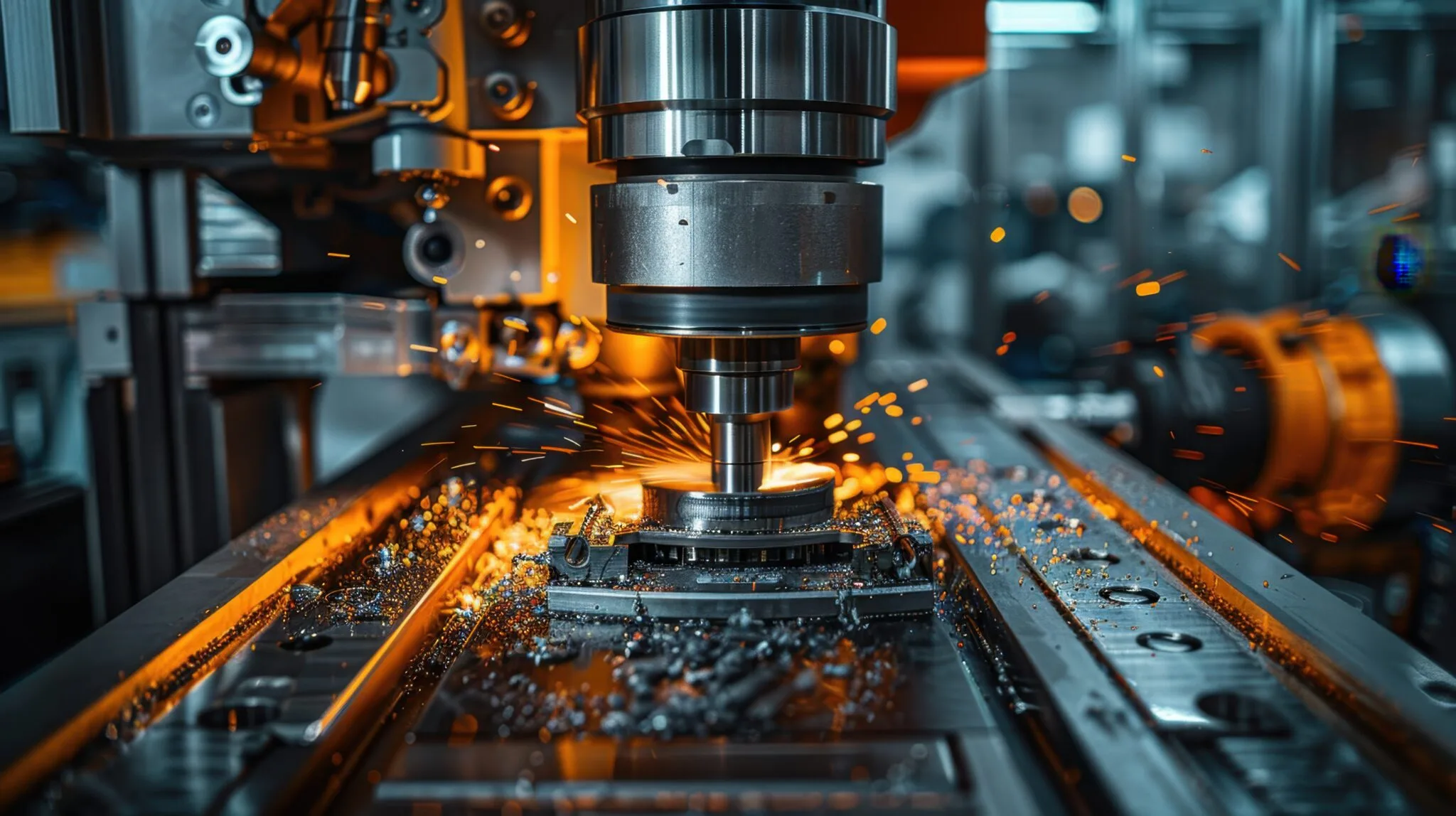

If you work in oil and gas, aerospace, or any kind of manufacturing in the UAE, you have seen CNC machining at work. Maybe you already buy machined parts. Maybe you are looking for a reliable supplier. Either way, this guide will tell you exactly what CNC machining is, how it works, and why it matters.
At Accurate Edge, we have been machining precision components from our Dubai Investment Park facility since 2007. We hold an API Monogram licence and serve oil and gas, petrochemical, aerospace, and industrial clients across the UAE and GCC. What we explain here is what we actually do every day on the shop floor.
What Is CNC Machining?
CNC stands for Computer Numerical Control. In simple words, it is a manufacturing process where a computer controls cutting tools to shape raw material into a finished part.
Before CNC, machinists moved tools by hand. It was skilled work but slow and inconsistent. CNC replaced manual controls with precise digital commands. The machine reads a program, moves its axes, and cuts the part exactly as designed. Again and again. Same result every time.
That is why industries like oil and gas and aerospace depend on it. When a valve body or a downhole tool component needs to be made to exact dimensions, you cannot rely on guesswork. You need CNC.
Standard CNC machining holds tolerances of around ±0.05 mm. With the right setup, you can achieve ±0.005 mm. That is thinner than a human hair.
How CNC Machining Works
Step 1: Design the Part
An engineer creates the part in CAD software. This is the digital blueprint that defines every dimension and feature.
Step 2: Plan the Cutting
The CAD model goes into CAM software. The programmer decides which tools to use, the cutting speed, and the exact path the tools will follow.
Step 3: Generate the Program
The CAM software produces G-code. This is the language CNC machines understand. It tells the machine where to move, how fast, and when to cut.
Step 4: Set Up the Machine
The operator loads the cutting tools, secures the raw material, and sets the reference points so the machine knows exactly where everything is.
Step 5: Machining
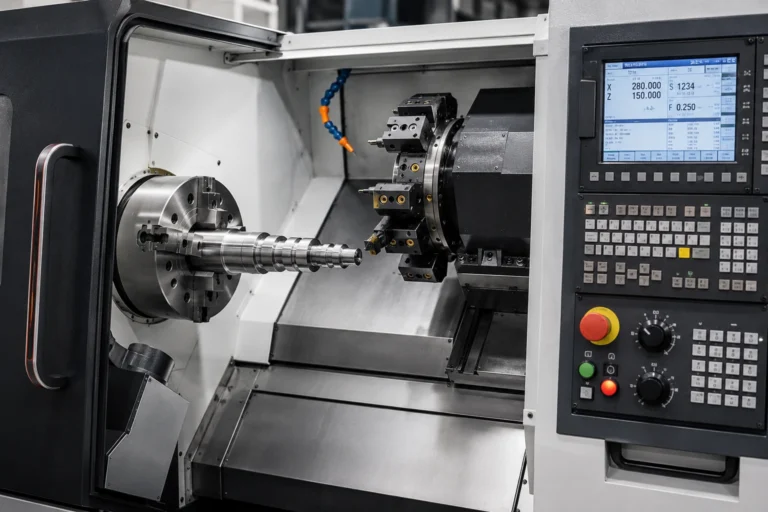
The machine does the work. Depending on the operation, it mills, turns, drills, bores, or threads the part. Modern multi-axis machines can do several operations in a single setup.
Step 6: Inspection
The finished part is measured against the drawing. Simple dimensions are checked with gauges and micrometers. Critical parts are measured on a CMM (Coordinate Measuring Machine), which maps every feature in three dimensions and produces a full inspection report.
Step 7: Surface Finishing
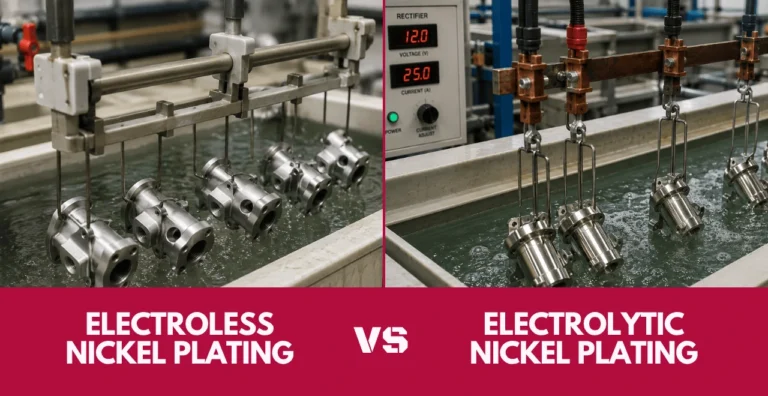
Many parts need treatment after machining. Honing brings bore diameters to final size with a smooth surface finish. Electroless nickel plating, PTFE coating, or copper plating adds corrosion and wear resistance. This is especially important for oil and gas and offshore components in the UAE.
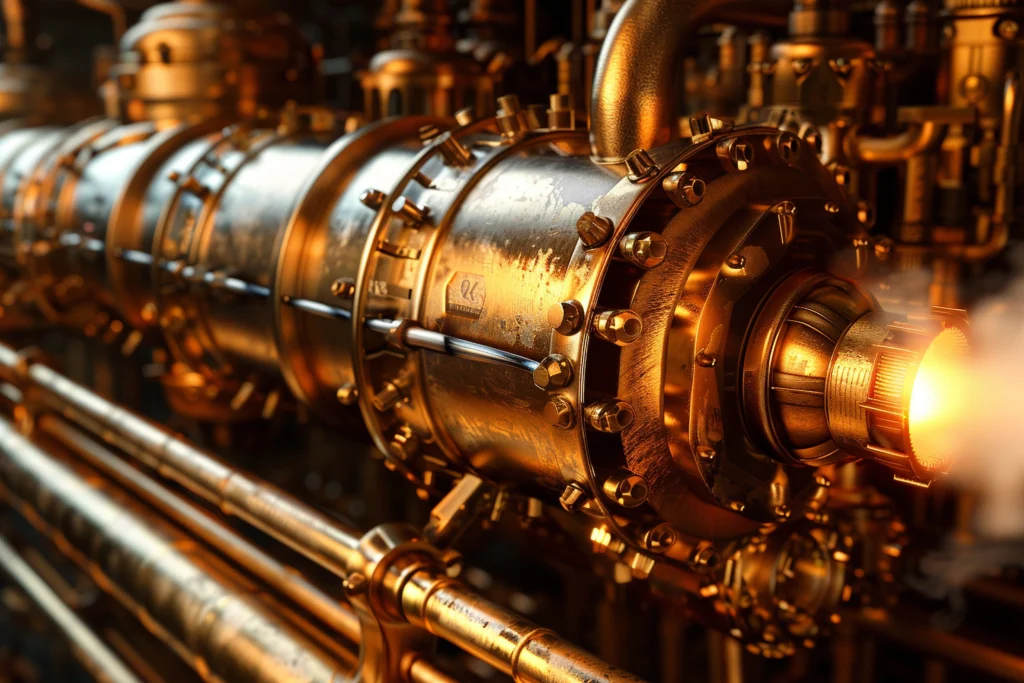
Types of CNC Machines:
CNC Milling
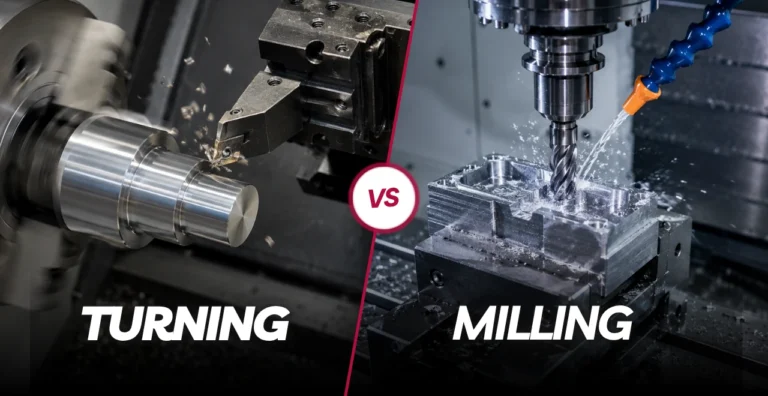
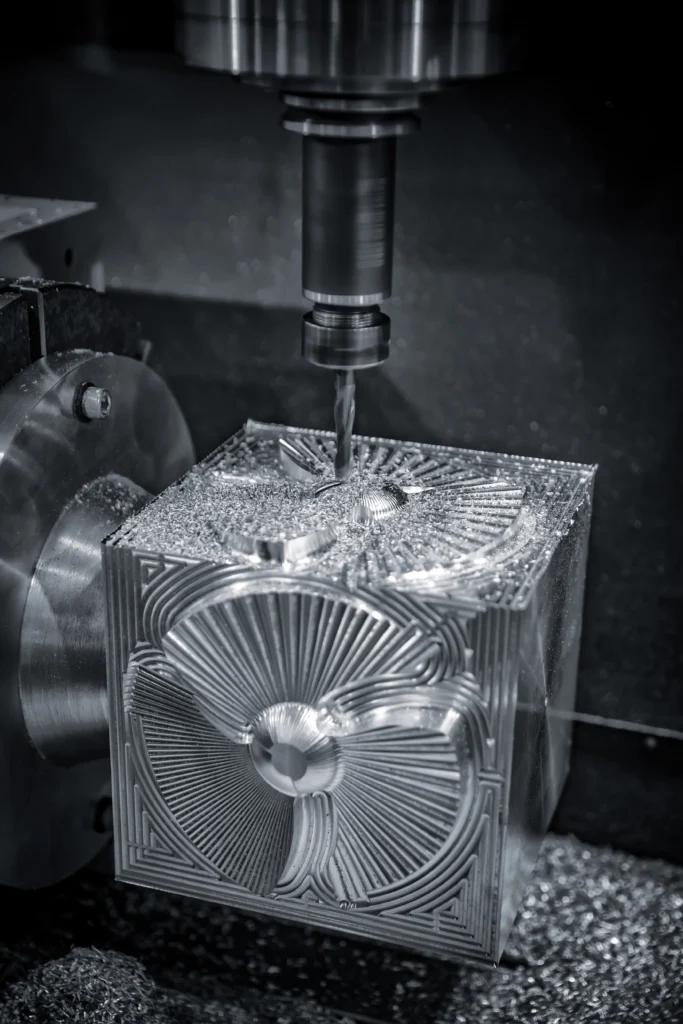
A rotating cutting tool removes material from a stationary workpiece. Used for flat surfaces, pockets, slots, and complex 3D profiles. A 5-axis milling centre can machine very complex shapes in a single setup.
Best for: Housings, brackets, flanges, structural components
CNC Turning
The workpiece rotates while a stationary tool shapes it. This is how you produce cylindrical parts with excellent roundness and surface finish.
Best for: Shafts, valve stems, spindles, bushings
CNC Drilling
Holes are produced at precise locations and depths. CNC drilling gives you positional accuracy that manual drilling cannot match, especially on complex bolt patterns or ported components.
Best for: Manifolds, hydraulic blocks, ported parts
CNC Grinding
An abrasive wheel removes very small amounts of material to achieve extremely fine surface finishes and tight tolerances. Usually the final step before a part is finished or coated.
Best for: Hardened components, critical fits, final sizing
Deep Hole Drilling
A specialist process for long, straight, accurate holes. At Accurate Edge, we offer deep hole drilling for components with length to diameter ratios greater than 10:1, which are common in oil and gas downhole tools and hydraulic cylinders.
Best for: Downhole tools, hydraulic cylinders, long bores
CNC Honing
Honing uses abrasive stones to bring bore diameters to final size with surface finishes as smooth as Ra 0.1 µm. It is a critical finishing step for hydraulic components and any bore requiring a precise fit.
Best for: Hydraulic cylinders, bores, precision fits
Where Is CNC Machining Used in the UAE?
Oil and Gas
Valve bodies, flanges, downhole tool components, manifolds, pressure vessel parts. These parts operate under extreme pressure, high temperatures, and corrosive conditions. Dimensional accuracy and material integrity are non-negotiable.
Accurate Edge holds an API Monogram licence. Our CNC machining services for oil and gas components are independently audited and certified to API standards.
Aerospace
Aircraft structural components, hydraulic system parts, engine brackets, avionics housings. Tolerances measured in microns. Materials like titanium, Inconel, and aerospace aluminium. CNC machining is the only practical way to produce these parts at the required accuracy.
Petrochemical and Industrial
Pump housings, gearbox components, heat exchanger parts, and custom fabrications for process plants. CNC machined parts fit correctly first time, reducing costly downtime during maintenance shutdowns.
Marine
Propeller shaft components, seawater resistant fittings, and structural parts for offshore platforms. Often machined from duplex stainless steel or exotic alloys for maximum corrosion resistance in the Gulf.
General Engineering
Custom jigs and fixtures, replacement parts, prototypes, and one-off components for machinery repair. CNC machining turns drawings into parts quickly, even for complex custom geometries.
Benefits of CNC Machining
- Precision that is actually reliable CNC machines hold tolerances that cannot be achieved by hand consistently. For safety critical parts in oil and gas or aerospace, this directly affects performance and safety.
- Same result every time Once a program is proven, every part produced matches the first one. Whether you need 10 parts or 1,000, the quality is identical.
- Faster turnaround Setup takes time upfront, but once done, machining runs fast. Complex parts that a manual machinist would spend days on can be completed in hours.
- Complex shapes are no problem CNC machines produce curves, angled features, undercuts, and 3D contours that are impossible to machine manually with any consistency.
- Works with almost any material Mild steel, stainless steel, duplex and super duplex stainless, aluminium, titanium, Inconel, copper alloys, brass, engineering plastics. CNC adapts to whatever your application needs.
- Less waste, lower cost Precise toolpaths remove only the material that needs to be removed. Less scrap means lower material costs per part.
- Full traceability Every CNC run generates digital records. Tool changes, feeds, speeds, inspection results. This traceability is essential for API, ISO, and AS9100 quality systems.
CNC Machining vs Manual Machining
People still ask whether manual machining has a place. For simple one-off repairs or very basic shapes, sometimes it does. But here is the honest comparison:
CNC machining holds ±0.005 mm. Manual machining typically holds ±0.1 mm. CNC produces identical parts across an entire batch. Manual results vary with the operator and how tired they are by the end of the shift. CNC handles complex 3D geometry with ease. Manual machining is extremely limited on complex shapes. For anything that matters in a critical application, CNC is not optional. It is the baseline.
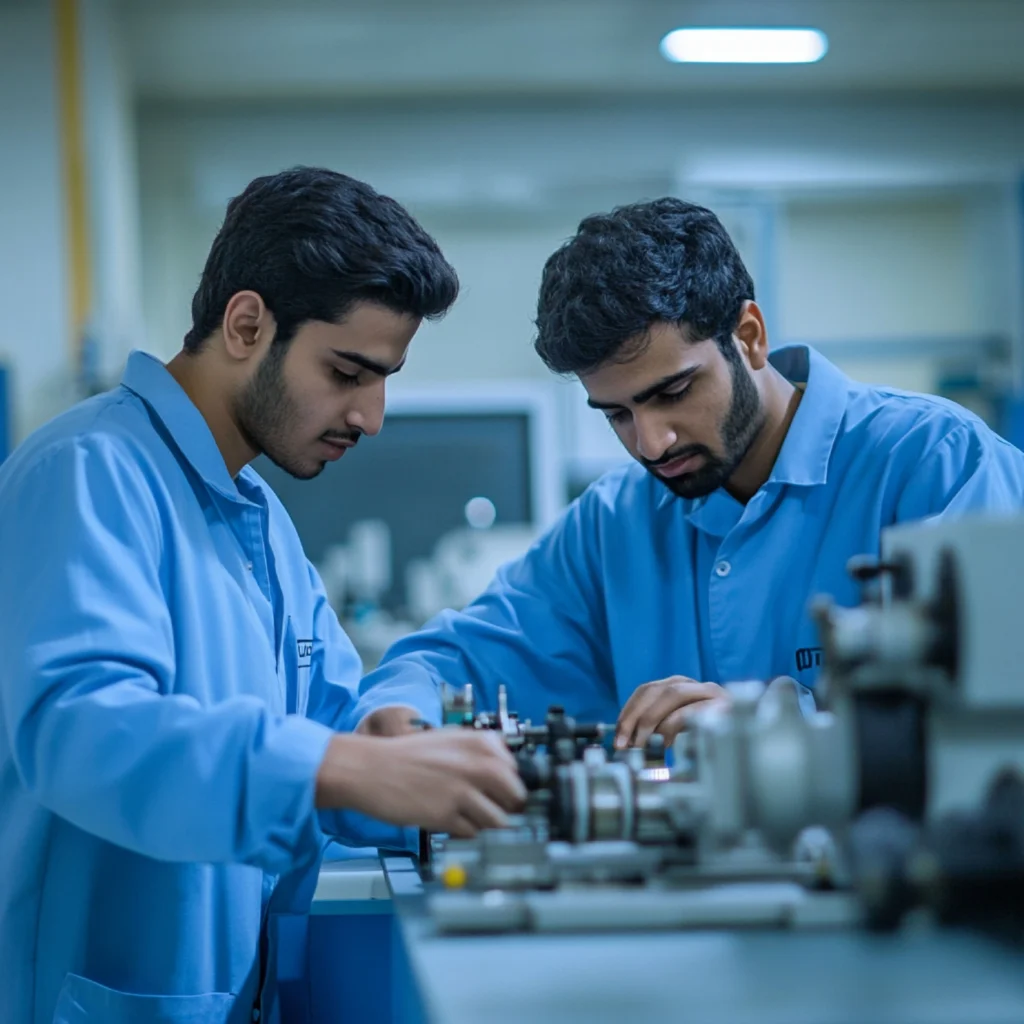
How to Choose a CNC Machining Supplier in the UAE
This is where most buyers make mistakes. They focus on price and ignore everything else that actually determines whether the parts will be right.
- Check the certifications API Monogram for oil and gas. ISO 9001 as the baseline for quality management. AS9100 for aerospace. Certifications are not just paperwork. They are independently audited proof that quality systems are actually in place and working.
- Ask about their machines Multi-axis machining centers, deep hole drilling capability, in-house grinding and honing. A serious precision machine shop has a range of equipment. A shop with only a few basic machines will struggle with complex components.
- Find out if they do finishing in-house A supplier that machines, hones, plates, and heat treats under one roof is far better than one that outsources those steps. Every hand-off is a risk. In-house finishing means one quality chain, one point of contact, faster lead times.
- Ask how they inspect Do they have a CMM? Can they provide full material traceability and inspection records with every delivery? For critical applications, inspection reports are not optional extras.
- Look at their industry experience A machine shop that understands API 6A, NACE MR0175, and the requirements of offshore and downhole applications is worth far more than a general shop that will machine anything.
At Accurate Edge, we offer CNC machining, deep hole drilling, honing, industrial coatings, heat treatment, welding, and full CMM inspection from our Dubai facility. Everything under one roof.
Frequently Asked Questions
What is CNC machining in simple terms?
A computer controls cutting tools to shape raw material into a finished part. The machine follows a digital program and removes material to produce parts to exact dimensions, repeatedly and accurately.
What materials can be CNC machined?
Steel, stainless steel, duplex and super duplex stainless, aluminium, titanium, Inconel, copper alloys, brass, and engineering plastics. The tools and cutting parameters are adjusted for each material.
How accurate is CNC machining?
Standard CNC machining holds tolerances of ±0.05 mm. With careful setup, ±0.005 mm is achievable. For bore diameters that need the tightest fits, honing after machining can achieve even finer accuracy.
What is the difference between CNC milling and CNC turning?
Milling uses a rotating cutter on a stationary workpiece, producing flat surfaces and complex profiles. Turning rotates the workpiece against a stationary tool, producing cylindrical parts. Many modern machines combine both.
Can CNC machining be used for small quantities and prototypes?
Yes. No hard tooling like moulds or dies is required. You can go from a CAD file to a finished prototype in days, test it, and proceed to production using exactly the same program.
What industries use CNC machining in the UAE?
Oil and gas, petrochemical, offshore, aerospace, marine, automotive, and general industrial manufacturing. Oil and gas is the largest sector because of the high volumes of precision components required for upstream and downstream operations.
What certifications should a CNC machining supplier in the UAE have?
API Monogram for oil and gas components. ISO 9001:2015 for general precision manufacturing. AS9100 for aerospace. These confirm the supplier’s quality system has been independently audited.
How do I get a CNC machining quote in Dubai?
Send your drawings, material specification, quantity, and applicable standards to your supplier. A good machine shop will come back with a quote and any design feedback within 24 to 48 hours.
Final Thoughts
CNC machining is the foundation of modern precision manufacturing. In the UAE, where oil and gas, aerospace, and industrial sectors demand the highest component quality, who you choose to machine your parts matters as much as the design itself.
The difference between a good machined part and a great one is not just the machine. It is the experience behind the program, the quality of the tooling, the care in the setup, and the discipline in the inspection.
Accurate Edge has been delivering precision CNC machined components from Dubai since 2007. API Monogram licensed. ISO 9001 certified. In-house honing, plating, and CMM inspection. If you have a drawing you want reviewed, contact our team or call us on +971 4 8858090. We will get back to you within 24 hours.