
Let me be straight with you.
Most articles about CNC turning are written for people who already know what CNC turning is. They throw around terms like “subtractive manufacturing” and “spindle RPM” without ever explaining why any of it matters to the person actually buying the parts.
This one is different. Whether you are an engineer specifying components for a Dubai oilfield project, a procurement manager sourcing precision parts for the first time, or someone who just needs to understand what they are actually paying for, this is written for you.
What is CNC Turning, Really?
Forget the technical definition for a second.
You have a piece of metal. A rod, a bar, whatever shape it came in from the supplier. You want it to become something specific, a shaft, a nozzle, a threaded fitting. Something round, precise, and consistent.
CNC turning is how that happens.
The metal spins. A cutting tool moves against it. Material comes off. What is left is the shape you need.
The CNC part, Computer Numerical Control, means a computer is directing every single movement. Not an operator’s hands. Not someone’s best guess. A program. Written once, tested once, then run the same way a thousand times without variation.
That is the whole idea. Precision you can repeat.
What is a CNC Turning Machine?
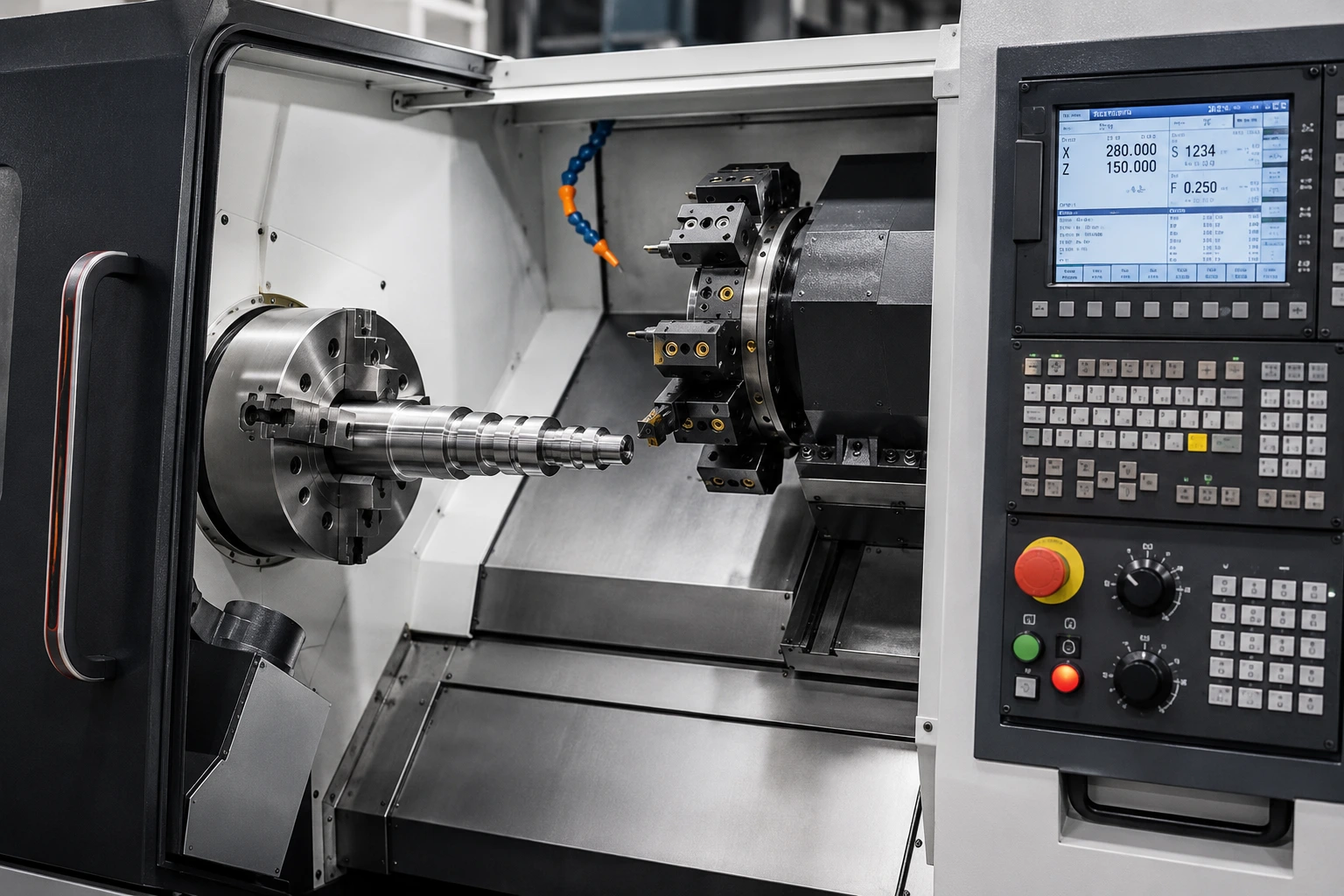
A CNC turning machine is, at its core, a lathe. But calling a modern CNC turning machine “just a lathe” is like calling a commercial aircraft “just a plane.”
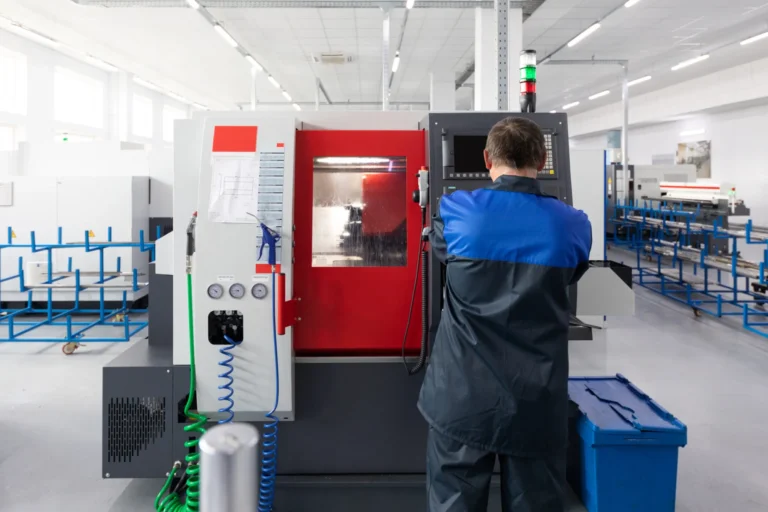
Today’s machines change their own tools automatically. They measure parts mid-cycle and adjust for wear. They run overnight without anyone in the building. Some of them machine both ends of a part without the operator ever touching it again after the first setup. To understand the full scope of what these machines can do, explore our CNC machining capabilities from design to final product.
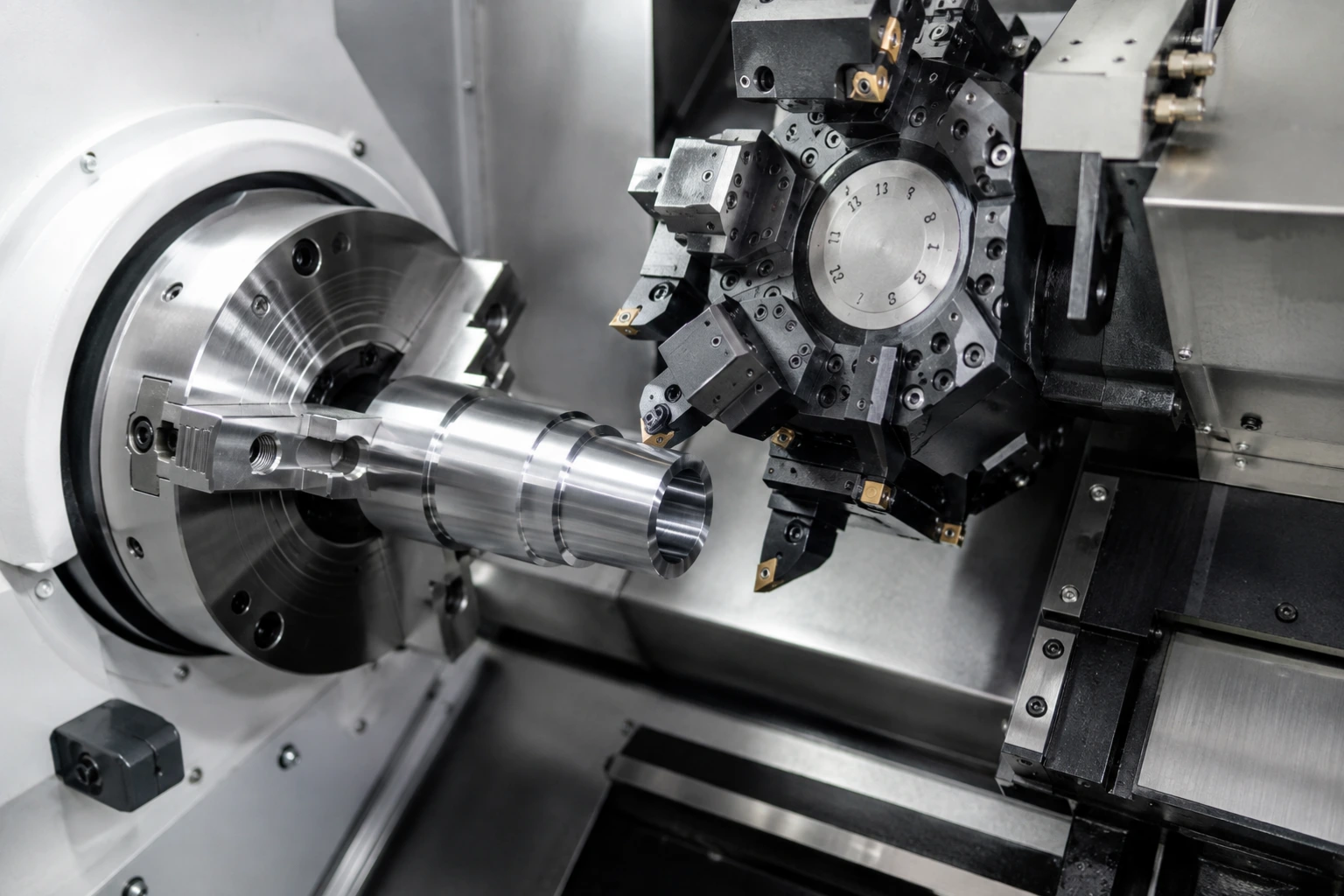
At Accurate Edge UAE, our CNC turning machines handle everything from small diameter precision pins to large flanges used in oilfield assemblies. Same building, same quality standards, completely different parts.
CNC Turning Machine vs. CNC Lathe Machine, Is There a Difference?
In most conversations, no. People use both terms to mean the same thing.
But if you want the precise answer, a CNC lathe machine is the physical equipment sitting on the workshop floor. CNC turning is the operation happening inside it. One is the tool. One is what you do with the tool.
Where the distinction actually matters is when you are comparing machine types. A basic CNC lathe only turns. A turn-mill centre does CNC turning & milling in the same setup. For complex parts, and there are a lot of complex parts in UAE manufacturing, that difference can cut your lead time in half.
What is CNC Turning and Milling?
Two processes. One machine.
CNC turning is for round features, outer diameters, bores, threads, grooves. The workpiece spins, the tool cuts.
CNC milling is for everything else, flat faces, pockets, cross-holes, slots. The tool spins, the workpiece stays.
CNC turning and milling on a single turn-mill centre means your part goes in once and comes out finished. No moving it between machines. No re-clamping errors. No waiting for the milling department to free up.
For oilfield components, aerospace parts, and anything with tight geometric tolerances, this matters a lot. Re-clamping a part introduces risk every single time. Eliminating that step eliminates that risk.
How the Process Actually Works?
Here is what happens from the drawing to the finished part.
Someone sends us a 3D CAD file or a 2D engineering drawing. Our programmers build the toolpath in CAM software, every cut, every speed, every depth of cut decided before the machine even starts. That program becomes G-code. The machine reads G-code.
Raw material goes into the chuck. The machine clamps it, confirms the setup, and starts cutting. The first pass is rough, fast, aggressive, removing the bulk of the material. The second pass is finished, slower, precise, bringing the part to its final dimension and surface quality.
Then inspection. Micrometer readings, CMM checks, thread gauge verification. Every critical dimension is measured against the drawing. For oil and gas work in particular, that inspection data goes into a report that ships with the parts. No report, no sign-off.
What Materials Can Be CNC Turned?
More than most people realise.
The common ones, aluminium, mild steel, stainless steel 304 and 316L, brass, copper. These are everyday materials in any machine shop.
Then you get into the more demanding alloys. Titanium. Inconel. Duplex stainless. These require specific tooling, lower cutting speeds, and a machinist who actually knows what they are doing. The material costs enough that you do not want to find out on your first batch that your supplier was figuring it out as they went.
Engineering plastics are also very workable on a CNC lathe, Nylon, POM, PEEK, PTFE. Medical device components, food-grade fittings, electrical insulators. All machinable.
In the UAE, 316L stainless is everywhere in petrochemical and marine applications. Corrosion resistance is not optional when your part spends its life near saltwater or aggressive process chemicals. Inconel comes up constantly in downhole oilfield components because of what it handles at temperature and pressure.
One thing, always ask for material traceability certificates. Every serious supplier provides them automatically. If yours makes it complicated, pay attention to that.
The ASM International materials database is worth bookmarking if you regularly specify materials for machined components.
Types of CNC Turning Operations:
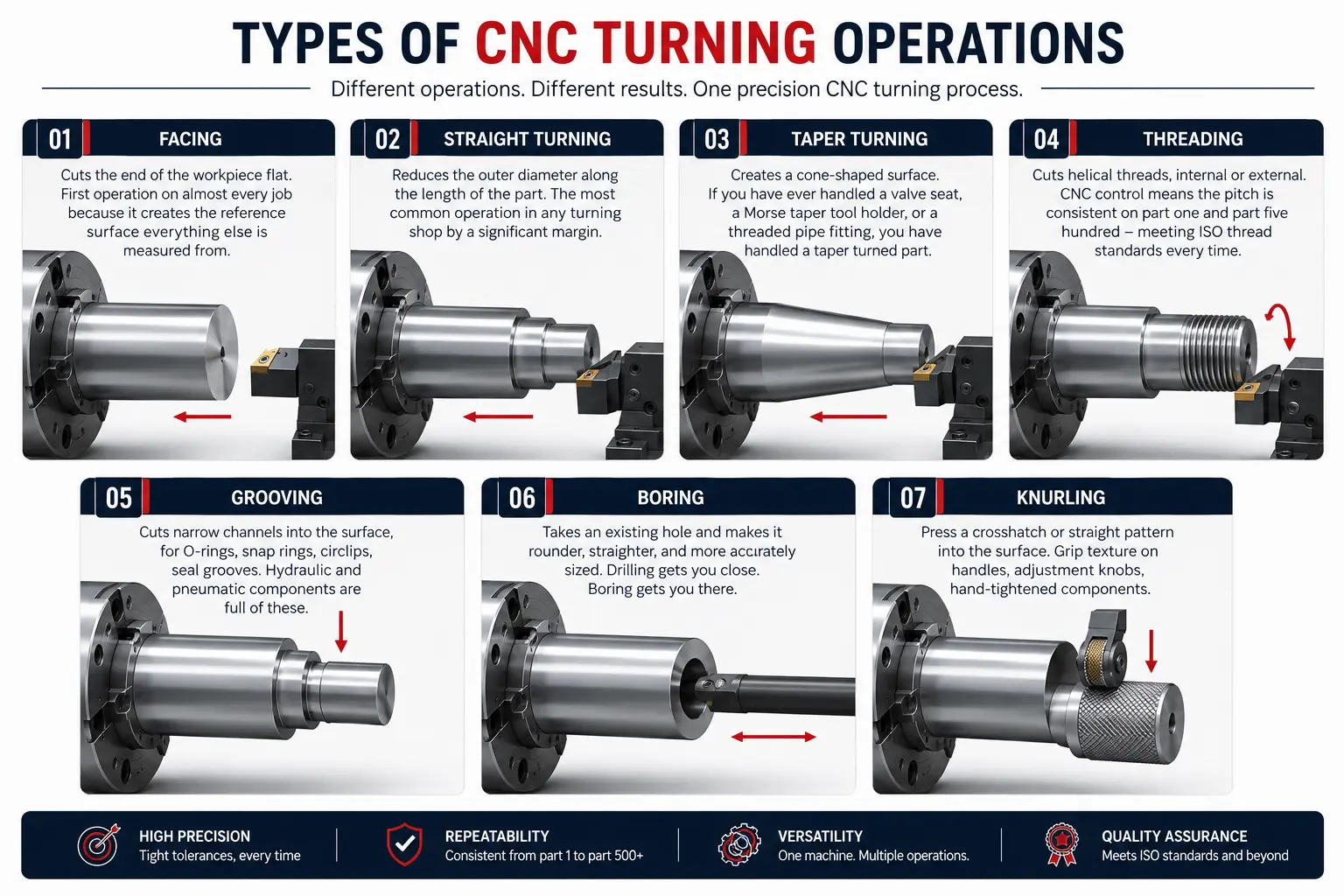
CNC turning is not one thing. It is a whole family of operations, each producing something specific on the part. Different operations often require different machines. Explore the full types of CNC machines and their applications.
Facing
Cuts the end of the workpiece flat. First operation on almost every job because it creates the reference surface everything else is measured from.
Straight turning
Reduces the outer diameter along the length of the part. The most common operation in any turning shop by a significant margin.
Taper turning
Creates a cone-shaped surface. If you have ever handled a valve seat, a Morse taper tool holder, or a threaded pipe fitting, you have handled a taper turned part.
Threading
Cuts helical threads, internal or external. CNC control means the pitch is consistent on part one and part five hundred – meeting ISO thread standards every time. Manual threading cannot say the same.
Grooving
Cuts narrow channels into the surface, for O-rings, snap rings, circlips, seal grooves. Hydraulic and pneumatic components are full of these.
Boring
Takes an existing hole and makes it rounder, straighter, and more accurately sized. Drilling gets you close. Boring gets you there.
Knurling
Press a crosshatch or straight pattern into the surface. Grip texture on handles, adjustment knobs, hand-tightened components.
Parting
The last operation on bar-fed work. Cuts the finished part off the end of the raw bar stock.
Why Do Manufacturers Actually Use CNC Turning?
Because it solves real problems that other processes do not.
When you need a part that is exactly 25.00 mm in diameter, not 25.03, not 24.97, exactly 25.00, a CNC turning machine is how you get there reliably. Manual machining can hit that dimension occasionally. CNC hits it every cycle.
When you need five hundred identical parts, the first one and the last one need to be the same. CNC repeatability makes that happen without anyone checking every part in between.
When your project timeline in Dubai is aggressive, and it usually is, fast cycle times and automated bar feeders mean parts that used to take days can be ready in hours.
Surface finish is another real advantage. A properly programmed finish turning pass produces Ra 0.4 µm or better. That is the kind of smoothness hydraulic sealing surfaces and precision bearing fits actually need.
And because machining removes only what needs to come off, material waste stays low. On Inconel or titanium, that efficiency directly affects your cost per component.
Defects That Happen in CNC Turning
Even good machines produce bad parts when something is off. These are the defects that come up most often.
Chatter marks
Ripple patterns on the surface. Almost always vibration, too much tool overhang, wrong spindle speed for the material, or a worn insert that is not cutting cleanly anymore.
Unintended taper
The diameter changes along the length when it should not. Usually a tailstock alignment issue or a problem with how the workpiece is being held.
Spiral marks
Visible helical lines on the surface. Feed rate too high, or an insert that has been in the machine longer than it should have been.
Dimensional drift
Parts that are in spec at the start of a run and gradually drifting out as the run continues. Tool wear and thermal expansion during long runs are the usual causes. These are managed through in-process gauging and tool wear compensation, keeping parts within ISO machining tolerances.
Burrs
Sharp edges where there should be clean breaks. A sign that edge breaking was not programmed in, or that the cutting parameters were not quite right for that material.
A professional CNC turning service catches all of this before it reaches you. First-article inspection on every new job. Statistical process control on production runs. If your current supplier is not doing both, your parts are less consistent than you think
CNC Turning Service in Dubai and the UAE
Oil and gas puts the biggest volume through machine shops across the emirate. Valve stems, coupling sleeves, nozzle assemblies, downhole tool components, all requiring certified materials, tight tolerances, full documentation. No shortcuts on any of it.
Aerospace MRO is significant too. Actuator shafts, bushings, housings for aircraft maintained at facilities across Dubai. Parts that need to be right the first time, every time.
Marine, construction, and MEP add their own demand. Propeller shafts, custom threaded fittings, anchor bolts, mechanical components for projects that cannot afford delays because a supplier missed a dimension.
If you are looking for a CNC turning service in Dubai that handles all of this, with proper material certification, full dimensional reporting, and lead times that actually work for your project, talk to Accurate Edge UAE. We quote quickly and we deliver on time.
Frequently Asked Questions About CNC Turning:
What is the difference between CNC turning and CNC lathe?
A CNC lathe machine is the physical equipment. CNC turning is the process that happens on it. In most conversations they mean the same thing, but technically the lathe is the hardware and turning is the operation.
Is CNC turning hard to learn?
For operators, yes. A year or more of experience is needed before someone is trusted on critical components. The programming knowledge, tooling experience, and setup skills take real time to develop. For buyers, that skill requirement sits with your supplier.
What are the types of CNC turning operations?
The main types are: Facing, Straight Turning, Taper Turning, Threading, Grooving, Boring, Knurling, and Parting. Each produces a specific feature on the finished component.
What are the defects of CNC turning?
Common CNC turning defects include chatter marks, unintended taper, spiral tool marks, dimensional drift, and burrs. All are preventable with proper setup, regular tooling inspection, and in-process measurement throughout the run.
What are the advantages of CNC turning?
CNC turning offers consistent accuracy, high repeatability across production runs, fast cycle times, excellent surface finish, and lower material waste compared to less controlled machining processes.
What is CNC turning and milling?
CNC turning and milling combines both operations on one machine (called a turn-mill centre). The part goes in once, gets fully machined, and comes out finished – no re-clamping, no transfer between departments, no repositioning errors.